The 2026 Spring Festival Gala served as a national showcase for China's AI-powered robotics. Five domestic tech firms—Unitree Technology, Magic Atom, Songyan Power, Galaxy General, and Yuejiang Technology—presented a diverse lineup of robots across fields such as martial arts, song-and-dance accompaniment, language programs, and everyday scenarios. Their flawless and stable performances vividly demonstrated the maturity and industrial capabilities of China's AI technology.
Supporting this achievement, patents—the primary embodiment of technological progress—serve as a key indicator of a country's overall AI industry strength. According to authoritative data, by the end of 2025, China held 60% of the world’ s AI patents, making it the largest holder of AI patents globally. The share of patents in core AI fields such as large models, computer vision, natural language processing, and robot motion control has continued to rise, with a steady increase in high-value invention patents. These patents not only provide strong intellectual property protection for the large-scale deployment of AI robots and related technologies but also underscore China’ s innovation capabilities and leadership in core AI domains.
The following analysis focuses on the global and domestic AI patent application layout and trends over the past five years (2021–2025)—a period marked by rapid technological advancement. These insights further reveal the competitive strength and evolving landscape of Chinese enterprises within the global AI innovation ecosystem, while offering a comprehensive view of the industrial development and value of AI technologies in China.
I. Global AI Patent Application Trends by Major Countries/Regions
Between 2021 and 2025, China led the world in AI patent applications, with a total of nearly 800,000—accounting for over 60% of the global share. The United States ranked second, though its number of applications was only about one-sixth of China’ s. In comparison, the European Patent Office, South Korea, and Japan each filed notably fewer applications than both China and the United States (see Figure 1-1). This distribution clearly reflects China’ s position as a dominant contributor to global AI patent filings, holding an indisputable lead in terms of application volume.
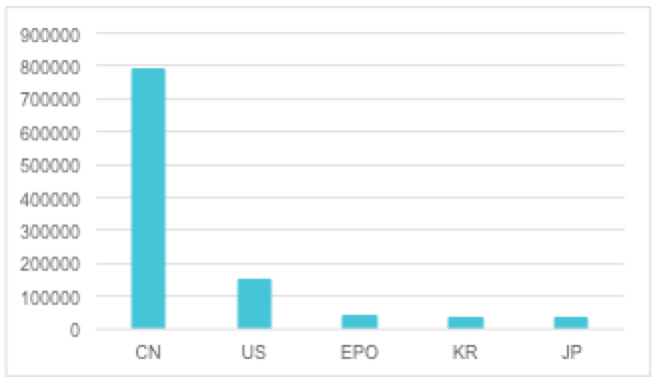
Figure 1-1
Beyond quantitative leadership, the technical landscape of global AI patent applications from 2021 to 2025 reveals that innovation remains highly concentrated in core fields such as G06F (electric digital data processing), G06N (computer systems, knowledge representation and reasoning), and G06Q (data processing systems or methods, e.g., for commerce and administration) (see Figure 1-2). At the same time, a notable trend of cross-domain integration is emerging. For instance, communication-related classifications—particularly H04L (transmission of digital information) and H04W (wireless communication networks)—account for a significant share of patents, underscoring that the convergence of AI with communication technologies, such as intelligent networks and edge computing, has become a key area of innovation.
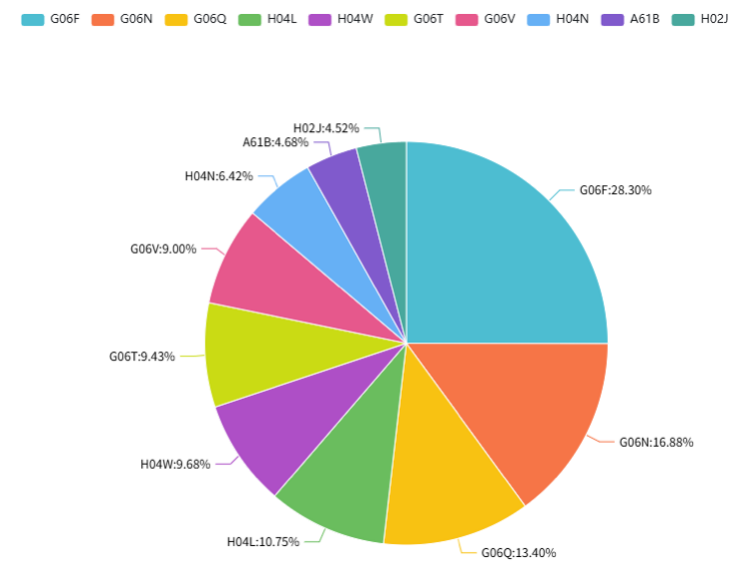
Figure 1-1
II. China's AI Patent Application and Layout
1. Analysis of Chinese AI Applicants
Among the top 10 AI patent applicants in China, nine are enterprises and one is a university (see Figure 2-1). This composition reflects a collaborative innovation model led by enterprises and supported by industry–university–research partnerships, which has become a key driving force behind China's AI development. Huawei ranks first in patent applications, followed by Tencent and State Grid Corporation of China. Notably, consumer electronics companies such as Xiaomi, vivo, and OPPO also hold prominent positions, highlighting the strong innovation vitality and broad application potential of AI technology in China’ s consumer terminal products.
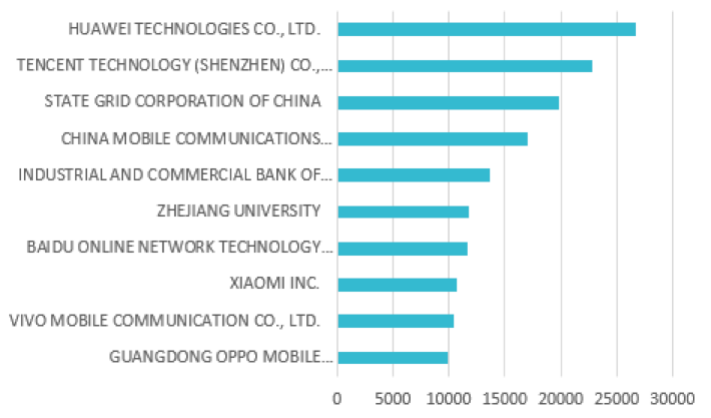
Figure 2-1
As shown in Figure 2-2, the annual application trends of the top 10 Chinese AI patent applicants from 2021 to 2025 reveal a pattern of “stabilizing growth after an initial surge,” in which leading institutions such as Huawei, Tencent, and State Grid Corporation of China have gradually moved into a phase focused on technological refinement and quality enhancement after reaching their application peaks.
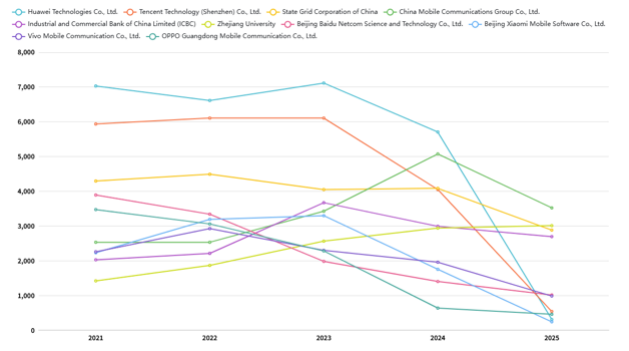
Figure 2-2
2. AI Layout of Major Chinese Applicants
The landscape of AI patent applicants in China is characterized by enterprise dominance, concentrated technical fields, and a well-defined echelon structure. In terms of technical focus, Chinese innovators concentrate their patent applications in core AI fields such as G06F (electric digital data processing) and G06N (machine learning), while also pursuing differentiated strategies aligned with their core businesses. For instance, telecommunications companies like Huawei and China Mobile have deepened their presence in H04W (wireless communication networks), driving the convergence of AI with the communication industry and advancing the intelligent evolution of 5G/6G. Meanwhile, Tencent, Baidu, and Zhejiang University emphasize G06T (image data processing or generation), reinforcing the application of computer vision and multimedia processing technologies in public services and the digital economy.
Note: It should be noted that each patent application corresponds to multiple classification numbers, and statistics are counted separately by classification number. As a result, the same patent application may be counted repeatedly. Therefore, the data in the figure do not represent the absolute number of patents of the applicants, but only reflect the relative scale of their layout in various technical fields.
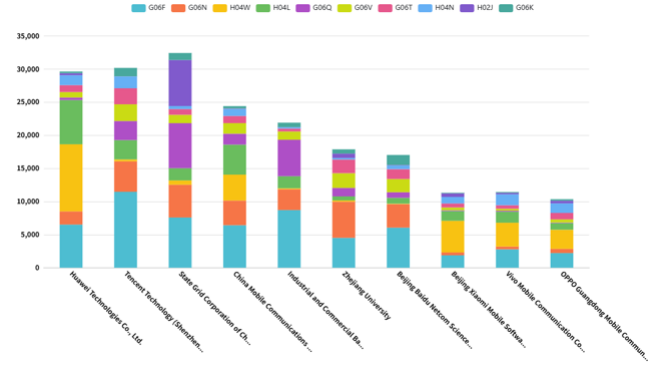
Figure 2-3
In summary, China has achieved robust growth in artificial intelligence and demonstrated remarkable strength in global AI patent layout. Driven by the rapid advancement and widespread adoption of generative AI technologies, the country is well positioned to make further breakthroughs in the field and strengthen its competitive edge across the entire AI industry chain. We will continue to monitor these developments closely.