I. Introduction
Since the formal implementation of the “Early Resolution Mechanism for Pharmaceutical Patent Disputes (patent linkage system)” in China, the maneuvering between innovative companies and generic companies has become a normalized practice. Previously, through an in-depth analysis of typical judicial and administrative cases from 2021 to 2024, we systematically reviewed the core framework and operational logic of the system, as well as the key disputes and practical challenges under the “judicial + administrative”dual-track system.
In the early stage of the system's operation, due to numerous disputes regarding acceptance conditions, substantive trial rules, and the criteria for determining whether a technical solution “falls within the protection scope of a patent right,” parties generally preferred to clarify rules through judicial proceedings. Courts also provided adjudicatory guidance for the implementation of systemic details by releasing typical judgements.
As Chinese Patent Linkage System enters its fifth year of implementation, the numerous disputes and practical difficulties existing in the early stage have been gradually clarified and resolved through judicial judgments and administrative rulings. The overall operation of the system has become stable and is exhibiting new development trends. Looking at the cases published in 2025, no judicial judgments issued throughout the year, while the number of issued administrative rulings increased by 120% compared to 2024 (increase from 45 to 99 cases).
This indicates that, at a time when key rules are becoming increasingly clear, the focus of the parties has shifted from “exploring system” to “pursuing efficiency,” with parties opting for the administrative adjudication route—which offers shorter trial cycles and more significant technical expertise—to substantively resolve disputes.
Therefore, by sorting out the public administrative rulings of pharmaceutical patent disputes issued in 2024 and 2025, this article endeavors to demonstrate the evolution in the selection of dispute resolution approaches, the formulation of dispute resolution strategies,and the focal points of administrative adjudication. This article further focuses on the analysis of typical cases, including (2024) CNIPA-Drug-Adjudication- No. 0067 and (2024) CNIPA-Drug-Adjudication- No. 0007, to explore the new challenges faced in current practice and provide strategic recommendations for the patent portfolios of originators throughout the entire product life cycle.
II. Overview
Based on a comparison between the administrative adjudication cases issued in 2024 and 2025, pharmaceutical patent disputes in 2025 exhibit the following characteristics in terms of case volume, case closure mode, and the distribution of disposition results:
Table 1: Overview of administrative rulings published in 2024
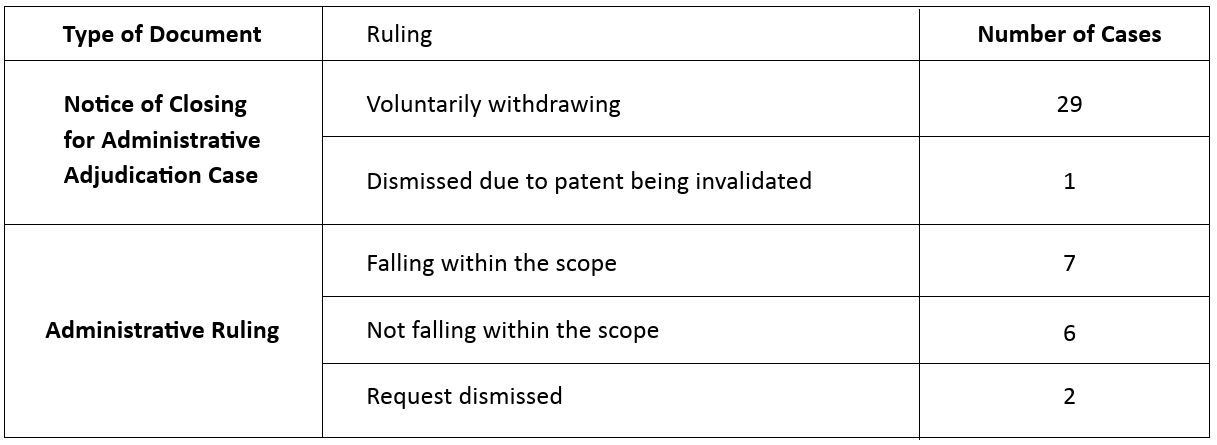
Table 2: Overview of administrative rulings published in 2025
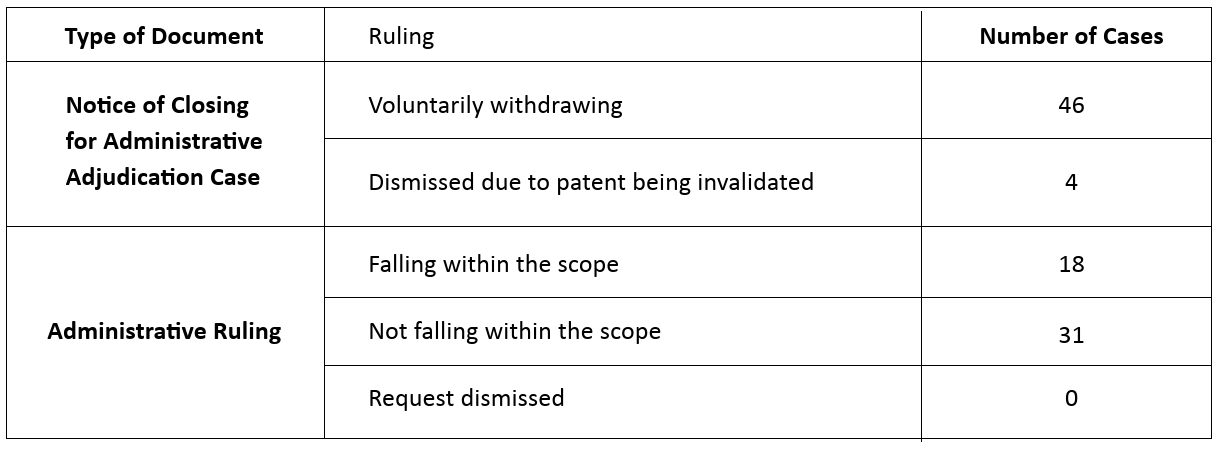
· Significant growth in case numbers, with increasing favor of administrative adjudication: The number of issued administrative rulings rose from 45 in 2024 to 99 in 2025, representing a year-on-year increase of 120%. This data reflects that, given the expedited nature of administrative adjudication proceedings, originators show a distinct preference for utilizing administrative adjudication to resolve pre-marketing patent disputes.
· Persistence of high withdrawal rates, reflecting effectiveness of the early resolution mechanism: Regarding the methods of case disposition, the proportion of cases concluded via "voluntary withdrawal" decreased from 64.4% in 2024 to 46.5% in 2025; nonetheless, it remains the primary mode of case closure. This indicates that the administrative adjudication mechanism has fully leveraged its functions in early-stage dispute resolution and the exchange of critical information. Through the exchange of evidence—particularly based on the generic applicants' obligation to submit the generic drug’ s application materials—all parties are able to obtain key information and assess infringement risks, thereby resolving disputes expeditiously through settlements or withdrawals. This has effectively conserved both enforcement costs and administrative resources.
· Rising proportion of substantive hearings, comprehensively resolving substantive issues: In 2025, the number of cases entering the substantive hearing stage (i.e., those resulting in rulings of "falling within" or "not falling within" the scope of protection) increased significantly. Specifically, the proportion of cases in which the CNIPA issued an administrative ruling following substantive review rose from 26.5% in 2024 to 49.5% in 2025. This indicates that as rules become increasingly refined and clarified, the focal point of administrative adjudication has shifted from procedural issues to substantive issues. Notably, cases ruled as "not falling within the scope of protection" involved eight patents from six drugs; among these, with the exception of one medical use patent, the remainder were all pharmaceutical composition patents. Regarding these composition patents, the grounds for ruling were highly concentrated on the application of the "All-Elements Rule" and the strict limitation of the "Doctrine of Equivalents." It is evident that the importance of pharmaceutical composition patents is becoming increasingly prominent, establishing them as a critical patent type within Chinese patent linkage system.
III. Analysis of Key Administrative Rulings
A. (2024) CNIPA-Drug-Adjudication- No. 0067—Latest Developments in the Upadacitinib Case
In 2023, two core compound patents in China for AbbVie’ s blockbuster drug, Upadacitinib, were respectively declared by the China National Intellectual Property Administration (CNIPA) as entirely invalid (parent patent) and partially invalid (divisional patent), becoming one of the most significant events in the Chinese pharmaceutical industry that year. The present administrative ruling involves the divisional patent of Upadacitinib, the uniqueness of which lies in the fact that while the picture claim for Upadacitinib was invalidated, the Markush generic claims covering Upadacitinib remained valid. Under such circumstances, ]whether Markush generic claims could be utilized for patent enforcement became a focal point.
In response, the CNIPA determined in (2024) CNIPA-Drug-Adjudication- No. 0067 that the technical solution of the drug for which registration was applied falls within the scope of patent protection, noting that “each claim constitutes an independent right, and any claim that is valid at the time of filing a request for administrative adjudication of a drug patent can naturally serve as the basis for such a request; the invalidation of a specific compound claim does not automatically imply that a generic compound claim encompassing said specific compound should exclude thatspecific compound from its scope of protection.”
Implications and Suggestions: The Importance of Establishing Multi-layered Markush Generic Protection for Compounds with Clear Structure-Activity Relationships
The outcome of this ruling underscores the critical role of Markush claims in maintaining patent validity. Even if the picture claim is determined to be invalid, Markush generic claims can still be utilized for patent enforcement, thereby providing patent protection for the drug.
This also imposes more stringent requirements on the drafting of compound patent applications. Taking the Upadacitinib divisional patent as an example, the reason why the picture compound was declared invalid while the Markush generic claims covering it remained valid is that the chemical structure of Upadacitinib was not recited in the priority document, and the specification lacked disclosure of experimental data for Upadacitinib, which consequently led to a finding of lack of inventive step. Conversely, the Markush generic claims with broader scope of protection (encompassing Upadacitinib), by virtue of being entitled to priority, was free of prior arts to challenge their inventive step and were thus maintained as valid.
The reasons are twofold: on the one hand, patent drafting and small-molecule drug R&D often proceed in parallel in practice. To secure earlier priority dates, applicants typically adopt a strategy of filing multiple priority documents in alignment with R&D progress, resulting in different specific compounds being entitled to different priority dates. On the other hand, it is generally difficult to predict the optimal candidates during the patent drafting stage, and core compounds may undergo changes as R&D and clinical trials advance.
In practice, it frequently occurs that originally intended candidates are abandoned in the later stages for various reasons, while compounds that were not prioritized initially and lacked experimental data in the patent specification eventually become the active ingredients of marketed drugs.
Therefore, in patent drafting, full consideration should be given to the uncertainties of R&D and clinical progress. It is essential to establish multi-layered Markush generic protection with well-defined structure-activity relationships (SAR) for compounds. Even for compounds without specific experimental data disclosure in the original patent specification, attempts should be made to construct Markush generic claims with clear SAR by referencing other structurally similar specific compounds with sufficient data, thereby achieving comprehensive strategic protection.
Discussion on the Legal Issue
The aforementioned decision also gives rise to a legal issue, namely: in the determination of infringement, can the technical solution of the specific compound that has been declared invalid still be protected by the Markush generic claim that remains valid?Regarding this issue, arguments for the negative position typically rely on the following grounds:
1) since the specific compound, as a dependent claim, has been declared invalid, it should be excluded from the scope of the Markush generic claim that serves as its independent claim;
2) based on the doctrine of prosecution history estoppel, the specific compound should not be included within the scope of protection of the patent right; and
3) the invalidation decision determined that the specific compound lacks an inventive step, meaning it has made no inventive contribution to the prior art; protecting a technical solution that lacks inventive contribution within a generic claim would violate the principle of fairness.
On the other hand, arguments for the affirmative position typically rely on the following grounds:
1) each claim constitutes an independent subject of patent right and possesses validity independent of other claims; even if a certain claim is recorded in the form of a dependent claim, any change in its legal validity does not automatically affect the legal validity of its corresponding independent claim;
2) regarding literal infringement, the application of the "All-Elements Rule" is sufficient to complete the infringement comparison; and
3) the determination that the patent right of the specific compound is invalid was made by the CNIPA rather than through a voluntary abandonment by the patentee, and there is no evidence indicating that the patentee has accepted this conclusion or waived its right to seek remedy; therefore, the doctrine of prosecution history estoppel does not apply.
To date, although the CNIPA has provided its own determination in the legal issue, there have been no judicial judgements providing interpretation or affirmation regarding this dispute.
B. (2024) CNIPA-Drug-Adjudication- No. 0007—Balance of Interests in the "Skinny Label" Strategy
(2024) CNIPA-Drug-Adjudication- No. 0007 is a typical case reflecting the application of the "Skinny Label" in Chinese pharmaceutical patent disputes. The case involves amedical use patent of Crizotinib Capsules (Patent No.: 200680045478.X) owned by Pfizer Products Inc. (hereinafter referred to as "Pfizer"), which only protects cancers mediated by anaplastic lymphoma kinase (ALK). However, the brand drug has been approved for two indications, namely anaplastic lymphoma kinase (ALK)-positive locally advanced or metastatic non-small cell lung cancer (NSCLC); and ROS1-positive advanced non-small cell lung cancer (NSCLC).
The CNIPA ruled that the generic drug did not fall within the scope of patent protection. The CNIPA determined that “the indications section of a drug package insert provides a definitive characterization of the drug’ s use for the prevention, treatment, diagnosis, alleviation, or adjuvant treatment of a specific disease (condition) or symptom. In administrative adjudication proceedings under the early resolution mechanism for drug patent disputes involving medical use patents, the technical solution of a generic drug should, in principle, be established based on the indications explicitly requested by the generic applicant in the drug package insert within the application materials, supplemented by an evaluation of other indication-related content in the application materials—for instance, the target patient populations specified in the dosage and administration section. The technical solution of the generic drug shall be comprehensively determined accordingly to judge whether it falls within the scope of protection of the medical use patent in suit.
If a generic drug applicant is able to excise from the approved drug package insert information pertaining to the indications protected by the patent in suit, the probability of patent infringement disputes arising subsequent to the drug's market listing will be further reduced. The generic drug may still achieve a smooth market entry provided it complies with relevant laws and regulations, and potential patent disputes will be favorably resolved through the generic drug applicant's due diligence and reasonable avoidance in the drafting of the drug package insert. This is more equitable and rational, and also facilitates the realization of the value inherent in the Early Resolution Mechanism for Drug Patent Disputes.”
It is evident that the CNIPA, in its administrative adjudication, maintains a position of fairness and reasonableness, striving to balance the interests of both originators and generics.
On one hand, the CNIPA has further refined the examination rules concerning medical use patents based on the principles of early dispute resolution, fairness, and reasonableness, aiming to mitigate the risk of induced infringement following the market launch of generic drugs at this stage, thereby safeguarding the legitimate rights and interests of originators.
In comparison with the reasons of the CNIPA's previous rulings in the Nintedanib Esylate cases ((2021) CNIPA-Drug-Adjudication- No. 0012 and No. 0013), the CNIPA has expanded the principle of indication comparison in the present case. In previous rulings, the CNIPA only emphasizes that the basis for infringement comparison is the indications explicitly recited in the package insert. The present ruling further clarifies that a comprehensive assessment of other indication-related content within the application materials is also required, and the scope of content to be excised by the generic drug applicant is not limited to the "Indications" section of the insert, but rather encompasses "information related to the indications claimed by the patent in suit." This evolution of the rules fully demonstrates that the CNIPA has recognized the potential risk that generic drug companies may retain suggestive technical descriptions in the insert, which could lead drug users to infer efficacy for the patented indications, thereby inducing the risk of "off-label use."
On the other hand, the CNIPA has provided administrative recognition for generic drug companies to circumvent indications protected by existing patents through the "skinny label" strategy during the generic drug application and examination stages. In this case, the CNIPA further clarified that so long as the package insert or filing materials do not contain information pertaining to the patent-protected indications—regardless of whether such indications were avoided in the initial filing or excised during the examination process—the generic drug shall be determined not to fall within the scope of protection.
Implications and Suggestions:
The CNIPA’ s recognition of the “skinny label” strategy underscores the critical importance of establishing a comprehensive patent protection system for every potential indication, particularly those already approved. In practice, whether due to the expiration of patents or the failure to obtain a patent for certain indications, generic drug applicants can circumvent patent-protected indications through the “skinny label” strategy to achieve market approval. Consequently, only by achieving full patent coverage for all approved indications can the premature market entry of generic drug companies be effectively blocked.
In scenarios where comprehensive protection for all approved indications is unattainable, the MAHs may still rely on the Early Resolution Mechanism for Drug Patent Disputes to initiate administrative adjudication proceedings, access the generic drug’ s application materials, and demand the excision of content in the package insert that allegedly constitutes “induced infringement,” thereby safeguarding their legitimate rights and interests to the greatest extent possible. Furthermore, the MAHs may extend their monitoring focus to the commercial sector, closely tracking potential “induced infringement” content in promotional materials, academic promotion, and other resources of generic pharmaceutical companies, to preserve evidence for initiating infringement litigation in accordance with the law when necessary.