Introduction
In the global innovation landscape, transnational patent applications have become a pivotal strategy for enterprises and inventors to protect intellectual property rights. However, there are significant differences among countries and regions regarding the requirements for inventor information in patent applications, which directly affect the preparation of patent applications and subsequent procedures. More profoundly, the disclosure of inventor information involves multiple considerations such as good faith, privacy protection, and legal compliance.
On November 13, 2025, the China National Intellectual Property Administration (CNIPA) announced the decision to amend the Patent Examination Guidelines on November 13, 2025. The revised guidelines officially took effect on January 1, 2026,which clarify that starting January 1, 2026, the identity information of all inventors must be completed in the Request Form all Chinese patent applications, and its authenticity must be ensured. This adjustment has garnered widespread attention and discussion. Taking this as a catalyst, this article outlines the specific requirements for inventor information disclosure in patent applications across the patent applications in the five major intellectual property offices (IP5)-China, the United States, Europe, Japan, and South Korea - as well as the World Intellectual Property Organization (WIPO). By comparing and analyzing the differences in the systems of various jurisdictions in terms of inventor identification, scope of information disclosure, and privacy protection mechanisms, this article aims to provide practical guidance for transnational patent portfolio.
I. China
Pursuant to Ruel 14 of the "Implementing Regulations of the Patent Law of China": "An inventor refers to a person who has made a creative contribution to the substantive features of an invention or creation." Based on the previ-ous "Patent Examination Guidelines" and the official template of the "Patent Application Request Form" of the CNIPA, inventor information was managed differently: If the first inventor is a resident of mainland China, it was mandatory to fill in the name, nationality, and ID card number simultaneously; if the first inventor is a foreigner (including residents of Hong Kong, Macao, and Taiwan), only the name was required, with no obligation to provide nationality, passport number, or other identity information; for other inventors, only the name was required.Section 4.1.2, Chapter1, Part I of the revised Patent Examination Guidelines, which came into force on January 1, 2026, amends the provisions regarding "Inventors" as follows (underlined parts indicate amendments):
"Rule 14 of the Implementing Regulations of the Patent Law stipulates that an inventor refers to a person who has made a creative contribution to the substantive features of an invention or creation. False inventors shall not be filled in. During the patent examination procedure, examiners generally do not examine wheth-er the inventor filled in the request form complies with this provision, unless there is evidence to show that the inventor filled in the request form does not comply with this provision.
An inventor shall be an individual (i.e., a natural person), the identity information of all inventors shall be filled in the request form, and the authenticity of the information shall be ensured. No entity, collective, or artificial intelligence name should be filled in the request form; for example, they shall not be written as 'XX Research Group' or 'Artificial Intelligence XX', etc."
Compared with the previous regulations, the Revision of the Examination Guidelines makes it explicit that an inventor must be a natural person, which is a further clarification of the issue of whether AI can be an inventor. In addition, the Revision also requires that the request form should fill in the identity information of all inventors and ensure its authenticity. This means that from January 1, 2026, Chinese patent applications will no longer distinguish between the first inventor and other inventors, and all inventors are required to provide their identity information.
As for the specific scope of required identity information, the Revision itself does not have further clarified regulations. Our understanding is that the Revision extends the requirements for the first inventor to all inven-tors, that is, for Chinese national inventors (i.e., holders of Chinese nationality), the identity information refers to their resident identity card numbers; for non-Chinese national inventors (including foreigners, and residents of Hong Kong, Macao, and Taiwan), it refers to their nationality. Our practical experience in submitting new applica-tions after January 1, 2026 confirms this understanding, that is, for Chinese national inventors, the Chinese ID card number must be filled in the Request Form; for non-Chinese inventors, nationality is a mandatory field, while the type and number of ID card are optional and may be left blank. A public letter from CNIPA’s Depart-ment of International Cooperation to the U.S. Embassy further clarifies that “In view of the considerable differ-ences in the types of identity documentation available to inventors in various countries, the CNIPA patent-pro-cessing system does not make ‘type of document’ and ‘document number’ mandatory fields for inventors or designers who are not of Chinese nationality. Only the names of such inventors and designers are disclosed publicly.”
Furthermore, in accordance with the Examination Guidelines, the CNIPA only publishes the names of inventors in the patent bulletin, patent application monograph, patent monograph, and patent certificate. Other personal information of inventors remains undisclosed, thereby effectively protecting the personal privacy of inventors.
The revision of the "Patent Examination Guidelines" this time has raised the requirements for inventor identity information, and its main purpose is to curb the behavior of applying for patents with false identities, ensure that patent applications are based on genuine innovative subjects, and enable patent rights to be granted to true innovators, thereby upholding the fairness and authority of the patent system. In light of this, applicants must prepare and verify the true identity information of each inventor in advance, improve the internal inventor infor-mation recording and management mechanism, and avoid legal risks caused by inaccurate information.
II. United States
Under 35 U.S.C. § 100(f), the term "inventor" means the individual or, if a joint invention, the individuals collec-tively who invented or discovered the subject matter of the invention. The United States Patent and Trademark Office (USPTO) reiterated in the " Revised Inventorship Guidance for AI-Assisted Inventions" revised in November 2025 that only natural persons can be inventors or joint inventors, and AI systems are prohibited from being listed as inventors.
Inventor information is primarily disclosed through the Application Data Sheet (ADS) and the Inventor's Oath or Declaration. Under 37 CFR § 1.76(b)(1), the ADS must set forth the legal name (consistent with birth certificates or marriage licenses), residence (city and state/country), and mailing address of each inventor. Furthermore, a U.S. patent application requires the inventor to either take an oath before an authorized person of the U.S. government or submit a written declaration, that is, the "Inventor's Oath or Declaration." Under 35 U.S.C. § 115(a) and 37 CFR § 1.63, "Inventor's Oath or Declaration" must use the inventor's legal name, and all inventors must sign the oath or declaration to attest that they are the original inventors of the claimed invention
Unlike China, the U.S. does not require the ID or passport numbers, but emphasizes ensuring effective communi-cation through a detailed mailing address. Applicants must ensure that all inventor sign the necessary documents prior to filing to avoid procedural delays.
III. Europe
Article 81 of the European Patent Convention (EPC) explicitly stipulates that an inventor must be designated in a European patent application; Rule 19 of the Implementing Regulations of the EPC stipulates that the inventor must provide: family name and given names of the inventor, the country and place of residence (after April 1, 2021). The European Patent Office (EPO) only conducts a formal review of the designation of the inventor and does not verify the accuracy of the information. It is also clear that the inventor must be a natural person, and AI lacks the necessary legal capacity.
In fact, the provisions of the EPC on inventor information have also undergone adjustments in recent years. Prior to the old regulations (before April 1, 2021), inventors were required to provide their full address. After April 1, 2021, the previously required full address was simplified to the country and place of residence. Simultaneously, Rule 19(3) and (4) EPC of the Implementing Regulations of the EPC were repealed, eliminating the procedure of sending notices to inventors who are not applicants or sole inventor, that is, the EPO no longer separately informs the relevant inventors of the designation of the inventor and the basic information of the patent application.
In addition, the rules for the public disclosure of inventor information have also been adjusted in parallel. Since November 1, 2021, the European Patent Register no longer publishes the full address of the inventor, only the family name, given names, country and place of residence are published. This modification, which is consistent with the adjustment of the requirements for the designation of inventors, aims to respond to the demands of data protection.
The above aforementioned revisions cover the requirements for inventor information, notification procedures, and the scope of public information. They have simplified the patent application procedures while strengthening the protection of inventor privacy by restricting the scope of public information, adapting to the technical trend of increasing accessibility of patent information.
IV. Japan
Article 36 of the Patent Act of Japan clearly stipulates that the applicants must submit an application form containing the relevant information of the inventor, including the name of the inventor, and the residence or domicile. The "name" is limited to the name of a natural person, excluding AI as an inventor; the "residence or domicile" must be a specific address that can be actually contacted, and the law does not require the provision of the inventor's nationality and identification number. If there are multiple inventors, the name and address information of each inventor must be recorded separately.
Compared with China, the United States, and Europe, Japan's inventor information disclosure focuses more on the practical function of communication, and does not list nationality as a mandatory item. While simplifying the requirements for submitting identity information, it also takes privacy protection into account, which is similar to the regulations in the United States and Europe, and is more simplified than the new regulations in China.
V. South Korea
Article 42(1) of the Patent Act of South Korea stipulates that the patent application form must record the name and address of the inventor, and the inventor must be a "natural person." Rule 4 of the Enforcement Rules of the Patent Act and Application Form No. 1, which came into effect on November 1, 2024, introduced major adjust-ments: "Nationality" and "Country of Residence" are now mandatory fields for all inventors, including domestic and foreign inventors. Under the old rules, foreign inventors could choose whether to list their nationality and country of residence. In addition, in practice under the new rules, domestic inventors are required to fill in their "ID card number" in the patent application form, while foreign inventors are not obliged to do so.
The revision of the Enforcement Rules of the Patent Act in November 2024 has significantly raised the mandatory disclosure information of inventors. The Korean Intellectual Property Office aims to standardize the identification of inventors, enhance the accuracy of inventor information to safeguard the rights of true inventors, and promote the advancement of the digital examination system to improve examination efficiency. Compared with the aforementioned patent offices, the requirements for inventor information in South Korea after the new rules are closer to those in China, both requiring the names, nationalities, and other identity information of all inven-tors, while the United States, Europe, and Japan are relatively more simplified.
VI. WIPO
Under the Patent Cooperation Treaty (PCT) system, the requirements for the disclosure of inventor information follow the principle of division between the international phase and the national phase: the international phase must comply with the provisions of the "Regulations under the PCT", and the national phase applies to the special requirements of the patent laws of the designated/selected countries.
Rule 4.6(a) of the Regulations specifies that the international application request form must contain the name and address of each inventor; if there are multiple inventors, they must be listed separately. If the applicant is the inventor, a corresponding declaration must be made. Regarding the address requirement, Rule 4.4(c) of the Regulations provides flexibility, stating the address should be indicated in such a way as to allow prompt postal delivery; an employer's address is acceptable. This mechanism aims to balance privacy protection and procedur-al convenience.
Pursuant to Rule 48.2(b)(i) of the Regulations and Section 4 of Annex D of the Administrative Instructions, the aforementioned inventor information is published together with the international application documents on PATENTSCOPE 18 months from the international application date or the priority date. The published content generally includes all the provided inventor names and addresses, but for the purpose of privacy protection, the postal address of the inventor is not displayed in a searchable text.
VII. Comparison and Analysis of IP5 and WIPO
Through the analysis of the patent application systems of China, the United States, Europe, Japan, South Korea, and WIPO, the following common requirements can be identified:
1. Inventors Must Be Natural Persons: All of the aforementioned countries/regions clearly stipulate that inven-tors must be natural persons and do not accept legal persons, organizations, or AI as inventors. This principle is clearly reflected in the laws of all countries, and the core is that the patent system only protects inventions made by humans and recognizes and protects the legitimate rights and interests of natural persons as the core subjects of invention and creation.
2. Name and Contact Address Are Basic Requirements: Most countries require the provision of the inventor's name and contact address, which are the most basic and core content of inventor information.
3. Formal Examination Is the Main Approach: Most countries adopt a formal review of inventor information without proactive verification.
For the ease of reference and comparison, the specific requirements for inventor information across the IP5 patent offices and WIPO are summarized in the table below:
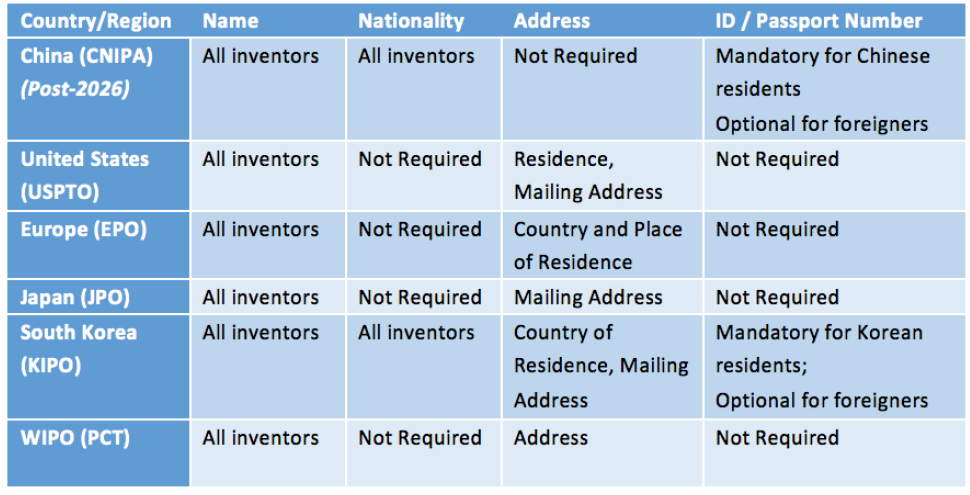
Key Differences: Europe has the most simplified requirements (no nationality or ID). South Korea has the most comprehensive requirements (names, nationality, and country of residence mandatory for all; ID for domestic inventors). China’s 2026 regulations align more closely with South Korea by raising requirements for nationality and identity information for all inventors to protect the rights of true innovators.
Conclusion
While all of the aforementioned countries/regions adhere to the basic principle that inventors must be natural persons, their paths toward privacy protection differ: Europe reduces the scope of publicly disclosed information, South Korea withholds sensitive information, and China emphasizes internal management security. This institutional divergence deeply reflects the varied trade-offs between protecting the rights of true inventors and safeguarding privacy across different countries.
For enterprises and individuals planning transnational patent portfolios, it is recommended to continuously pay attention to the legal dynamics of the target countries, prepare multi-language inventor dossiers in advance, entrust professional patent agencies to navigate complex cross-border application procedures, and build a sound inventor information management system, thereby laying a solid foundation for global patent strategy and portfolios.