The combined application system for designs provides strong institutional support for innovative entities to comprehensively protect their design solutions. This guide aims to sort out the relevant regulations and examples of the combined application system for designs, guide innovative entities to accurately understand and use the combined application system for designs, improve the quality of writing and responding to design patent applications, better safeguard the legitimate rights of applicants, and promote the high - quality development of the design patent system.
Chapter 1 Overview of Combined Applications for Design Patents
1. Relevant Laws, Regulations and Provisions
Paragraph 2, Article 31 of the "Patent Law of the People's Republic of China" (hereinafter referred to as the Patent Law) stipulates that "an application for a design patent shall be limited to one design. Two or more similar designs of the same product, or two or more designs for products of the same category that are sold or used in sets, may be filed as one application."
Article 40 of the "Rules for the Implementation of the Patent Law of the People's Republic of China" stipulates that "in accordance with the provisions of Paragraph 2, Article 31 of the Patent Law, when multiple similar designs of the same product are filed as one application, other designs of the product shall be similar to the basic design specified in the brief description. The number of similar designs in an application for a design patent shall not exceed 10.
Two or more designs of products of the same category that are sold or used in sets, as referred to in Article 31, Paragraph 2 of the Patent Law, refer to products that belong to the same class in the International classification , are customarily sold or used simultaneously, and whose designs have the same design concept.
The above provisions clarify that an application for a design patent shall be limited to one design. Meanwhile, the above provisions also clarify two exceptional situations. That is, multiple similar designs of the same product or two or more designs of products of the same class that are sold or used in sets can all be filed as one application.
It should be noted that whether it involves two or more similar designs of the same product or the designs of products in a set, in addition to meeting the relevant provisions for combined applications mentioned above, each design or the design of each product should also meet other requirements for grant of patent rights. Otherwise, the combined application cannot be granted a patent.
2. Situations where an application for a design patent can be filed as one case
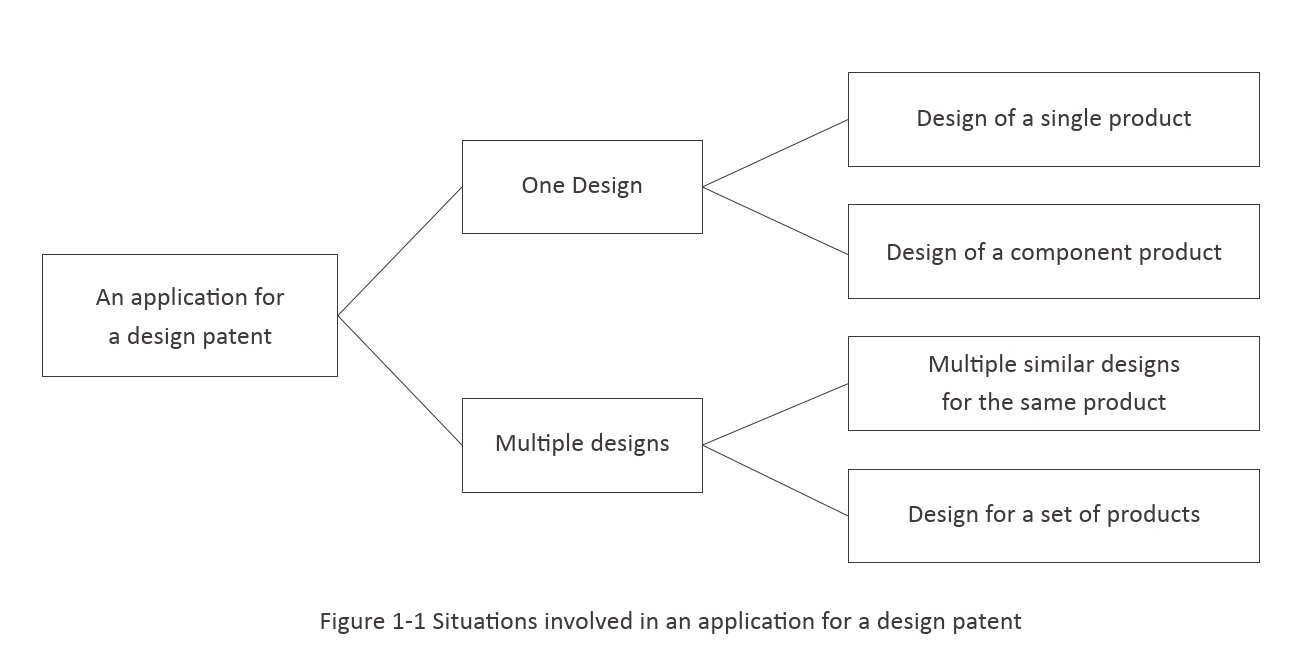
As shown in Figure 1-1, for a design, it includes two types: the design of an inseparable single product and the design of an inseparable component product. Here, a component product refers to a product composed of multiple combined components.
For multiple designs, that is, the designs that can be applied for in a combined application, which this guide focuses on, it includes two or more similar designs for the same product, and two or more designs for products belonging to the same class and sold or used in sets.
The number of similar designs in an application for a design patent shall not exceed 10. In theory, there is no limit to the number of designs for a set of products. After the combined application is granted, each design of the similar designs or each design of the set of products can be used as the basis for the right - holder to claim rights independently, and can also be declared invalid independently.
It should be noted that a component product refers to a product composed of multiple combined components, which belongs to one design rather than multiple designs. Therefore, it does not fall into the situation of a combined application for designs. After the relevant application is granted, a single component of the component product cannot be used as the basis for the right - holder to claim rights independently, nor can it be declared invalid independently. This guide includes it for introduction in order to help innovative entities better understand the combined application system.
Chapter 2 Application for the Design of Component Products
A component product contains multiple individual components. Each component has a close connection in structure or use, and only when combined together can the product achieve its purpose and reflect its use value. Component products can be divided into three situations according to the assembly relationship: unique assembly relationship, non - unique assembly relationship, and no assembly relationship.
For a product composed of multiple components with different specific shapes or patterns, if the components themselves cannot be sold or used independently, then these components do not belong to the objects protected by design patents. For example, a set of jigsaw puzzles composed of plug - in blocks of different shapes only belongs to the object protected by design patents when all the plug - in blocks are applied for as one design.
1. Component products with a unique assembly relationship
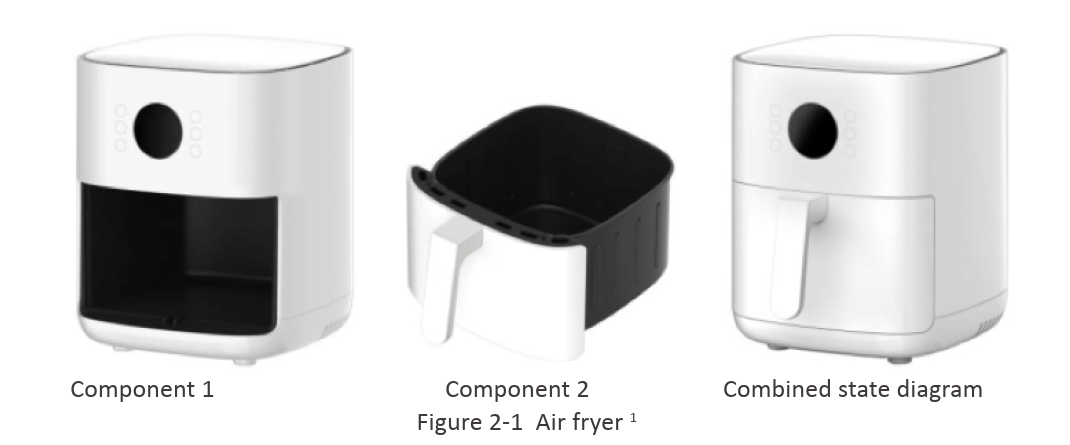
A component product with a unique assembly relationship refers to a product composed of multiple detachable components, and the assembly relationship between each component is unique and definite. For component products with a unique assembly relationship, the applicant shall submit a product view in the combined state. In order to clearly show the design of the product to be protected and the detachable characteristics of each component, in addition to submitting the view in the combined state, it is recommended to further submit views of each component.
The air fryer shown in Figure 2-1 is assembled from Component 1, the pot body, and Component 2, the fryer. The two are physically connected, so it belongs to a component product with a unique assembly relationship.
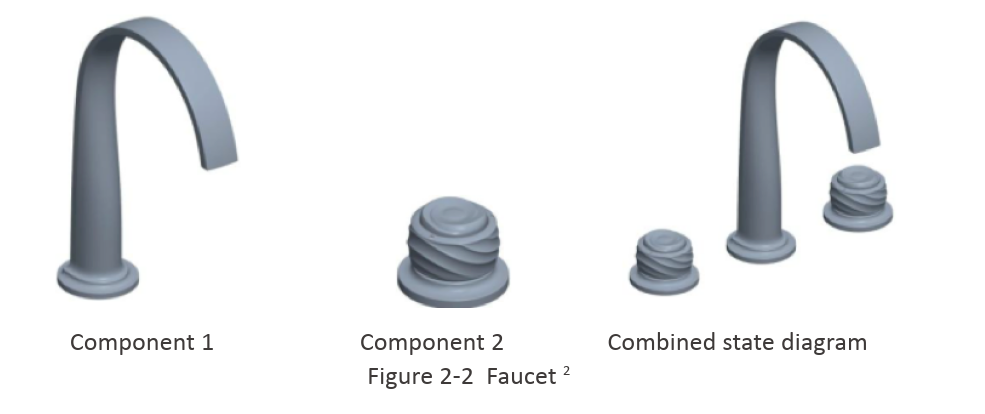
For the faucet shown in Figure 2-2, Component 1 is the faucet, Component 2 and Component 3 are the cold and hot water control switches respectively. Component 3 is the same as Component 2, so the view of Component 3 is omitted. There is no direct physical connection between the faucet and the control switches, but the assembly relationship among the three is unique and definite, so it belongs to a component product with a unique assembly relationship.
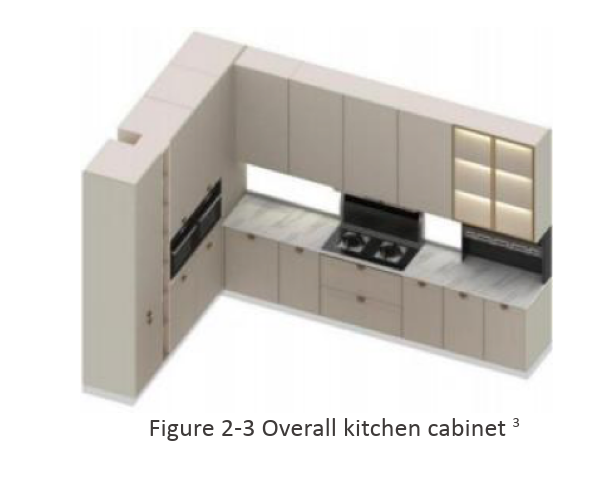
Overall integrated products are usually composed of multiple single products or modules with different functions combined together, having a unified visual effect, and also belong to component products with a unique assembly relationship. The overall cabinet shown in Figure 2-3, whose cabinet body, cooker, range hood, oven, etc. jointly achieve the overall cooking function and present a unified visual effect, belongs to a design.
2. Component products with non-unique assembly relationships
Component products with non-unique assembly relationships refer to products composed of multiple separable components. There are multiple assembly relationships among the components. Each component cannot be sold or used separately, and the product
function can only be realized when they are combined into one. For component products with non-unique assembly relationships, views of each component shall be submitted.
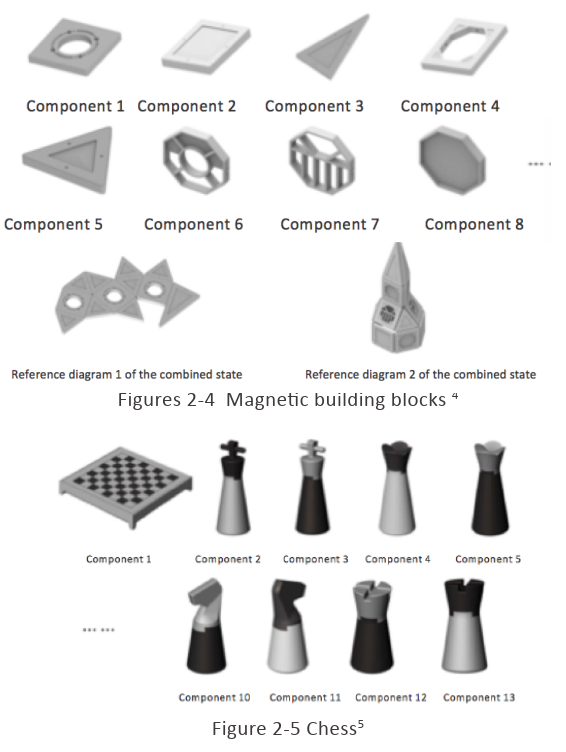
As shown in Figure 2-4, the magnetic building blocks contain multiple components and can be assembled into various different shapes by plugging. They belong to component products with non-unique assembly relationships. For the same building block components, only the view of one component may be submitted, and the reason for omitting the views of other components shall be stated in the brief description.
3. Component products without assembly relationship
Component products without assembly relationship refer to products in which there is no assembly relationship between components. Among them, each component cannot be sold or used separately, and the functions of the product can only be realized when they are combined into one. For component products without assembly relationship, views of each component shall be submitted.
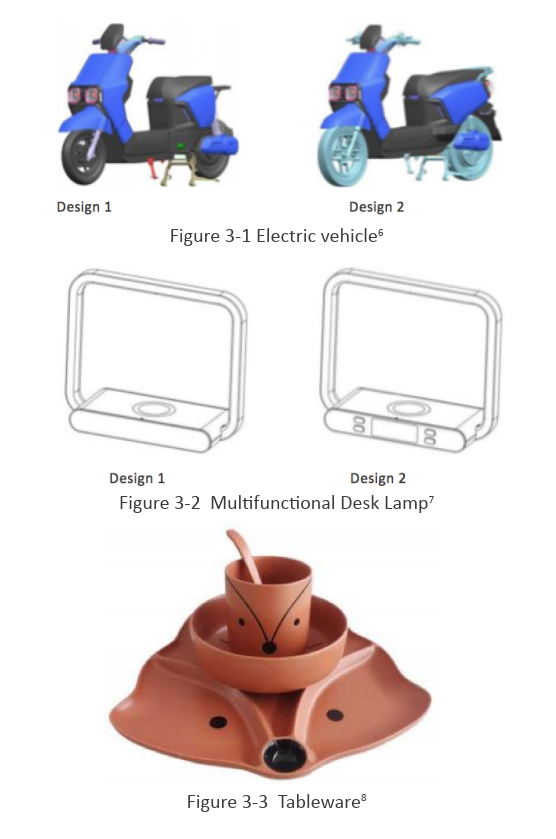
As shown in Figure 2-5, the chess can only realize its functions when 32 chess pieces and the chessboard are combined together, which belongs to a component product without assembly relationship. For the same chess pieces, only the view of one chess piece can be submitted, and the reason for omitting the views of other chess pieces shall be stated in the brief description.
Chapter 3 Combined Application for Multiple Similar Design Patents of the Same Product
Multiple similar design patents of the same product include two or more similar design patents for a single product or a component product. In addition to the requirement that the number of similar design patents in one application shall not exceed 10, multiple similar design patents shall also meet two conditions: First, the products corresponding to each design patent shall belong to the same product; second, the other designs in the multiple designs shall be similar to the basic design.
1. Shall belong to the same product
Each design patent in one application shall be the entire or partial design patent of the same product. The same product refers to products with the same product name and the same use.
The same product can be divided into the same product with a single use and the same product with multiple uses. The electric vehicle shown in Figure 3-1 is the same product with a single use.
The same product with multiple uses refers to products with at least some of the same uses. As shown in Figure 3-2, the multi-functional desk lamp, Design 1 is a desk lamp with a wireless charging function, and Design 2 is a desk lamp with a wireless charging function and an alarm clock function. Both can be used for lighting and belong to the same product with multiple uses.
It should be noted that the classification of products and the identification of the same product are not directly equivalent. For the tableware shown in Figure 3-3, plates, saucers, cups, and spoons are all tableware. Although these products belong to the same class in the International Classification of Industrial Designs, due to their different product names, they are not the same product and do not meet the conditions for similar design patents. However, a combined application for a set of product design patents can be considered.
2. They should belong to similar designs.
The applicant shall specify one design as the basic design in the brief description. The basic design mainly serves as a reference object, and the remaining designs shall be similar to the basic design respectively, as shown in Figure 3-4. The selection of the basic design may affect whether the designs can be applied for in a combined application.
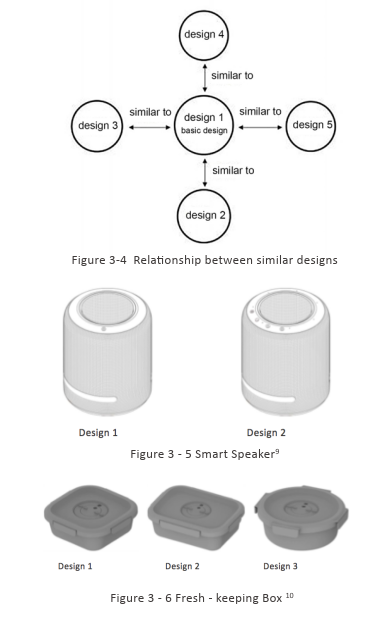
Generally, through overall observation, if other designs and the basic design have the same or similar design features, and the differences between them lie in partial minor changes, common designs of such products, repeated arrangement of design units, regular changes in the position and/or proportional relationship of partial designs in the whole, or only changes in color elements, etc., then the two are usually considered to belong to similar designs.
2.1 The difference lies in minor partial changes
Minor partial changes include minor partial changes in the shape, pattern, and color of the product. For the smart speaker shown in Figures 3 - 5, Design 1 is the basic design. Compared with the basic design, the only difference in Design 2 is the number of buttons on the upper - surface ring - shaped component, which belongs to a minor partial change in shape. Design 1 and Design 2 belong to similar design in appearance.
2.2 The difference lies in the conventional design of this type of product
For the fresh - keeping box shown in Figures 3 - 6, Design 1 is square and is the basic design, Design 2 is rectangular, and Design 3 is circular. These three shapes are conventional designs in the field of fresh - keeping boxes. Design 1 to Design 3 belong to similar design in appearance.
2.3 The difference lies in the repeated arrangement of design units
The overall basic design serves as a design unit, and other designs have multiple identical design units. Although the number of design units varies, if the difference only lies in the repeated arrangement or combination of design units in a certain way, then other designs and the basic design belong to similar design.
As shown in Figure 3 - 7, Design 1 of the seat is the basic design, and Design 2 is derived from the simple repeated arrangement of Design
1. Design 1 and Design 2 belong to similar design of appearance.
In addition, if other designs involve the repeated arrangement or combination of part of the product structure of the basic design as a design unit, then other designs and the basic design usually belong to similar design. The part of the product structure used as a design unit is allowed to have minor partial variations and does not have to be completely identical.
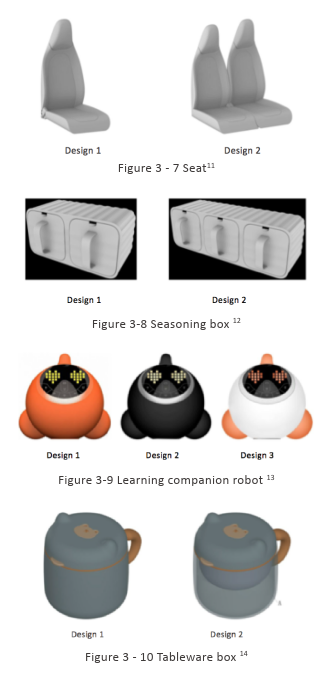
As shown in Figure 3 - 8, Design 1 of the spice box is the basic design. Each pull - out spice cup can serve as a design unit. Design 2 results from the repeated addition of design units. Design 1 and Design 2 belong to similar design of appearance.
2.4 The difference lies in the change of color elements
This situation refers to the case where, compared with the basic design, other designs have the same shape and pattern, and the difference lies in the overall or partial change of color elements.
As shown in Figure 3-9, for the learning companion robot, Design 1 is the basic design, and Designs 1 to 3 all claim protection for colors. Compared with the basic Design 1, only the colors of Design 2 and Design 3 have changed, and the color change has not produced a special visual effect. Therefore, Designs 1 to 3 belong to similar designs with similar appearances.
2.5 Other situations that can be regarded as similar designs
If the overall shape, pattern and their combination of other designs are the same as or similar to those of the basic design , and the two only have changes in transparency, semi - transparency and opacity, and the overall visual effect has not changed significantly, they belong to similar designs with similar appearances.
As shown in Figure 3 - 10, for the tableware box, Design 1 is the basic design, and in Design 2, Part A is made of transparent material. The internal structure shown due to transparency does not cause an obvious change in the overall visual effect, so the two belong to similar designs with similar appearances.
If the transparency of the material reveals more internal design details, resulting in an obvious change in the overall visual effect, then it does not belong to a similar design with a similar appearance.
If other designs only involve the replacement of common materials compared with the basic design and do not cause changes in the product's appearance, the two are the same appearance design and cannot be filed as a combined application for similar designs, such as crystal bracelets and acrylic bracelets.
If the overall shape, pattern, and their combination between other designs and the basic design are the same or similar, and only the length, width, and height ratios are different, and the overall visual effect does not change significantly, then they belong to similar designs.
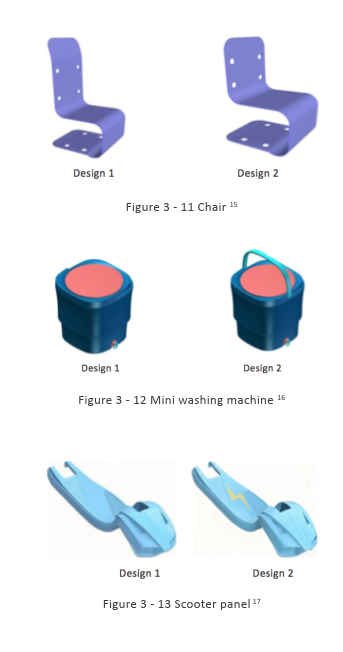
As shown in Figure 3 - 11, for the chair, Design 1 is the basic design. The only difference between Design 2 and the basic design lies in the different length, width, and height ratios of the chair, and the overall visual effect does not change significantly. Design 1 and Design 2 belong to similar designs.
If other designs are derived from the basic design, or take the shape, pattern, or their combination of the basic design as the main body, and the shape, pattern, and their combination of the main part are the same or similar, with only differences in the partial components of the product and no obvious change in the overall visual effect, they belong to similar designs.
For the mini washing machine shown in Figure 3 - 12, Design 1 is the basic design. The difference between Design 2 and the basic design is that Design 2 has a handle, which accounts for a relatively small proportion in the overall product design and belongs to a partialand minor change. Design 1 and Design 2 belong to similar designs.
If other designs are completely the same as the basic design in terms of shape elements, and the main difference lies in the increase or decrease of surface patterns, with no obvious change in the overall visual effect, they belong to similar designs.
For the scooter panel shown in Figure 3 - 13, Design 1 is the basic design. Compared with the basic design, the difference in Design 2 is that a lightning pattern is added to the product surface. Design 1 and Design 2 belong to similar designs.
2.6 Situations that are obviously not similar designs
If other designs do not belong to the same product as the basic design, they cannot be filed as one application.
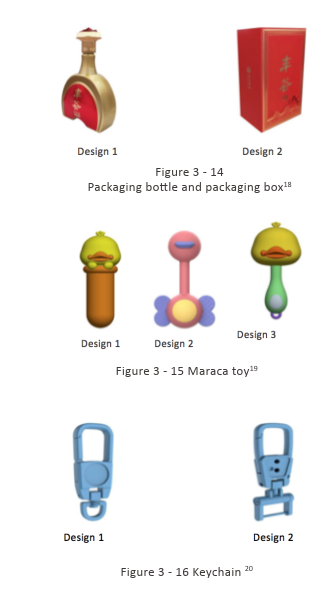
As shown in Figure 3 - 14, the packaging bottle and the packaging box. Design 1 is the packaging bottle, and Design 2 is the packaging box. The names of the two products are different, and they do not belong to the same product. They cannot be filed as a combined application in the form of similar designs, but can be considered for a combined application in the form of a design for a set of products.
Through overall observation, if other designs do not have the same or similar design features as the basic design, they cannot be filed as a combined application for similar designs. If other designs have the same or similar design features as the basic design, but the
proportion of these features in each design is relatively small, or they belong to the conventional designs of this type of product, resulting in a large difference in the overall visual effect, they also cannot be filed as a combined application for similar designs.
As shown in Figure 3 - 15, for the maraca toy, Design 1 is the basic design, and Designs 1 to 3 all claim protection for colors. After overall observation, Design 2 has a large difference in overall shape and color from Design 1 and does not have the same or similar design
features. Design 2 and Design 1 are not similar designs. Although Design 3 has similar design features in the upper - part design as the basic design, the proportions in the overall design are different, and the lower - part design is also significantly different, resulting in a large difference in the overall visual effect. Design 3 and Design 1 are also not similar designs.
As shown in Figure 3 - 16, Design 1 of the keychain is the basic design. Compared with Design 1, Design 2 has the same buckle structure at the upper part. However, the above - mentioned structure is a common design in this field. The shapes and structures of the middle and lower parts are quite different, and the overall visual effect is not unified. Therefore, the two designs do not belong to similar designs.
Chapter 4 Combined Application for Design of a Set of Products
A set of products refers to products composed of two or more (including two) independent products belonging to the same class, with the same design concept for each product. Each product has independent use value, and when combined, the products can reflect their combined use value. At the same time, each design of the set of products should be the an entire design of the product, rather than the partial design of the product.
1. Belonging to the same class
Belonging to the same class means belonging to the same class in the "International Classification of Industrial Designs". Belonging to the same class is not a sufficient condition. The requirements of being habitually sold or used as a set and having the same design concept should also be met.
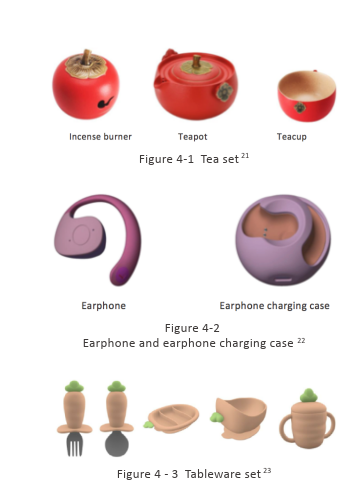
As shown in Figure 4 - 1, the tea set includes an incense burner, a teapot, and a teacup. The incense burner belongs to Class 11 in the "International Classification of Industrial Designs", while other tea - drinking utensils belong to Class07. The incense burner and other tea- drinking utensils do not belong to the same class and cannot be applied for as a design of a set of products.
As shown in Figure 4-2, the earphone and the earphone charging case. The earphone belongs to Class 14 of the "International Classification of Industrial Designs", while the earphone charging case belongs to Class 13. The two do not belong to the same class and cannot be applied for as a combined application in the form of a design for a set of products.
2. Sold or used as a set
Sold or used as a set means that the products are customarily sold or used simultaneously and have a combined use value. For the requirement of being sold or used as a set, it is sufficient to meet either one.
2.1 Sold simultaneously
Sold simultaneously means that the products with industrial designs are customarily sold simultaneously, rather than requiring them to be sold simultaneously. However, products randomly paired and sold for promotion should not be considered as customarily sold simultaneously and cannot be applied for as a set of products.
2.2 Simultaneous use
Simultaneous use refers to the common practice of using design products together. That is, when using one of the products, users will associate it with the existence of another or several other products, rather than using these products at the same moment.
As shown in Figure 4 - 3, the tableware set includes forks, spoons, plates, bowls and cups. The products have a unified design style, are usually sold together, and are used in coordination during meals. Moreover, when using one of the products, users will also think of the other products. Therefore, it meets the conditions of being habitually sold or used simultaneously.
2.3 Having combined use value
Having combined use value means that each product can be used alone, and multiple products can also be used in combination. The combined use of multiple products can be due to close functional connections, cultural and customary requirements, or decorative needs.
As shown in Figure 4 - 4, the couple rings with a unified design style can be worn separately. The ingenious design of their shapes allows them to form a new shape when combined, which is more decorative and interesting, reflecting their combined use value.

3. The design concepts of each product are the same.
Having the same design concept means that the design styles of each product are unified. That is, the designs made for the shape, pattern, or their combination, as well as the combination of color with shape and pattern of each product are unified.
The unity of shape means that each component product is characterized by the same specific shape, or there is a specific shape combination relationship among the component products.
The unity of pattern means that the themes, compositions, and presentation forms of the pattern designs of each product should be unified. If there is a difference in one aspect, the patterns are considered non - unified.
Regarding the unity of color, it cannot be considered separately and should be considered together with the shape and pattern of each product as a whole. When the shapes and patterns of each product meet the conditions of unity and coordination, without a request for color protection, the design concepts are the same; when there is a request for color protection, if the color styles of the products are consistent, the design concepts are the same; if the color changes of each product are significant and disrupt the overall harmony, they cannot be applied for as a set of products in a combined application.
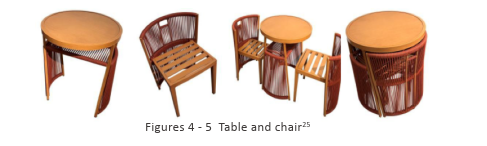
As shown in Figures 4 - 5, the table and chair have mutually matching and coordinated shapes and colors, with a unified design style, and belong to products with the same design concept.
4. It should be the entire design of the product.
A partial design cannot be filed as a combined application in the form of a design for a set of products. Whether it is a entire design and a partial design, or a partial design and another partial design, they cannot be filed as a combined application.
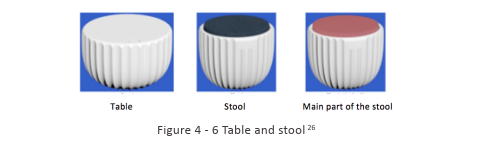
As shown in Figures 4 - 6, the table and the stool are entire designs that meet the conditions for a design for a set of products and can be filed as a combined application. The main part of the stool does not claim protection for the cushion part of the stool covered by the red semi - transparent layer, which is a partial design. The main parts of the table and the stool cannot be filed as a combined application in the form of a design for a set of products.
Chapter 5 Combined Applications for Partial Designs
Patent applications for partial designs also need to follow the principle of "one design, one application". The partial design of a product cannot be filed as a combined application in the form of a design for a set of products. Therefore, combined applications for partial designs are limited to the situation of combined applications for multiple similar designs of the same product.
1. Situations where it can be regarded as one design
Two or more unconnected partial designs of the same product can be regarded as one design if they are functionally or design - wise related and form a specific visual effect.
1.1 Having a functional relationship
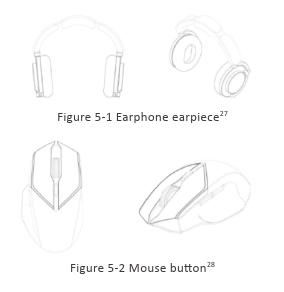
If various parts without a direct connection relationship are used in cooperation to achieve the same function, or have the same or similar uses and functions, they can be regarded as having a functional association. As shown in Figure 5-1, the two earpieces of the same earphone are used in cooperation with each other to achieve the same function, so they have a functional association.
1.2 Having a design association
If various parts without a direct connection relationship are coordinated and unified in design, echo each other, have a unified design concept, the same or similar design features, and have the same, symmetrical or corresponding relationship in shape or position, etc., they can be regarded as having a design association.
As shown in Figure 5-2, although there is no direct connection relationship between the two buttons of the same mouse, the two buttons have a symmetrical structural design, a unified design concept and echo each other, so they can be regarded as having a design association.
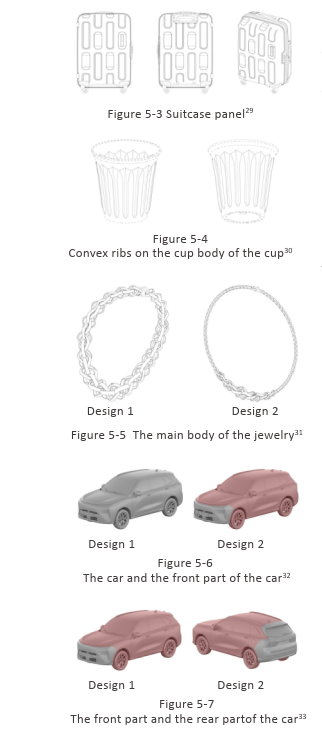
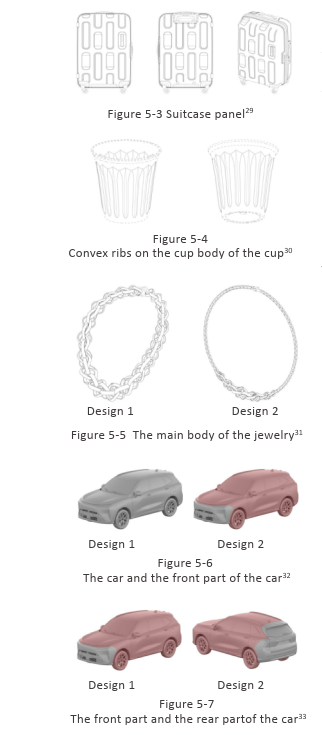
As shown in Figure 5-3, the surface structures of the front and rear panels of the suitcase are all designed with several staggered runway shapes. They have a unified design concept and the same design features in design, so they can be regarded as having a design association.
As shown in Figure 5-4, for the convex ribs on the cup body of the cup, the part claimed for protection consists of several convex ribs without direct connection. Each convex rib has the same design features. The cooperation of these convex ribs can achieve functions such as anti - slip, showing an association in terms of function and design.
2. Combined application for multiple similar designs of the same product
The conditions for a combined application for similar partial design and a combined application for entire design are the same. They should also meet two conditions: belonging to the "same product" and being "similar designs". The difference is that the features of the partial design claimed for protection should be considered.
2.1 It should belong to the same product
If the entire products on which other designs and the basic design rely are the same product, then they belong to the same product.As shown in Figure 5-5, for the main designs of two pieces of jewelry, Design 1 and Design 2 claim for protection the parts other than the connecting buckle. If both Design 1 and Design 2 are necklaces, they belong to the design of the same product; if Design 1 is a bracelet and Design 2 is a necklace, they do not belong to the design of the same product.
2.1.1 Entire and partial
As shown in Figure 5-6, for the car and the front part of the car, Design 1 is the entire appearance design of the car, and Design 2 is the partial appearance design of the front part of the car. Since the entire products of both Design 1 and Design 2 are cars, they belong to the same product. However, the partial part that Design 2 requests to protect has an obvious visual difference from the entire part that Design 1 requests to protect, so they do not belong to similar appearance designs.
2.1.2 Partial and partial
As shown in Figure 5-7, for the front part and the rear part of the car, Design 1 is the design of the front part of the car, and Design 2 is the design of the rear part of the car. Although the partial parts that Design 1 and Design 2 request to protect are different, the entire products they rely on are both cars, so they belong to the same product. However, the overall visual effect of the partial appearance design that Design 2 requests to protect is significantly different from that of Design 1, so they do not belong to similar appearance designs.
2.1.3 Parts and Partial Areas
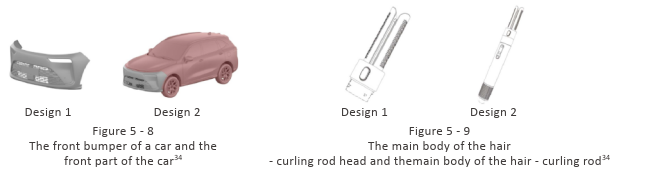
As shown in Figures 5 - 8, which illustrate the front bumper of a car and the front part of the car. Design 1 is an entiredesign of the car's front bumper, while Design 2 is the partial design of the front part of the car. Although both designs aim to protect the front bumper of the car, since the entire product of Design 1 is the car's front bumper and that of Design 2 is the car, they do not meet the requirement that the entire products they rely on are the same. Therefore, they do not belong to the same product.
2.1.4 Parts of Component Products and Partial Parts of entire Products
As shown in Figures 5 - 9, which depict the main body of the hair - curling rod head and the main body of the hair - curling rod. Design 1 is the partial design of the main body of the hair - curling rod head, and Design 2 is the partial design of the main body of the hair -curling rod. The entire product of Design 1 is the hair - curling rod head, and that of Design 2 is the hair - curling rod. Therefore, they do not belong to the same product.
2.2 Should Be Classified as Similar Designs
The factors considered for whether a partial design is similar to the basic design are basically the same as those for the entire design. The difference is that the position and/or proportional relationship of the partial design in the entire product also need to be considered.
2.2.1 Entire and Partial
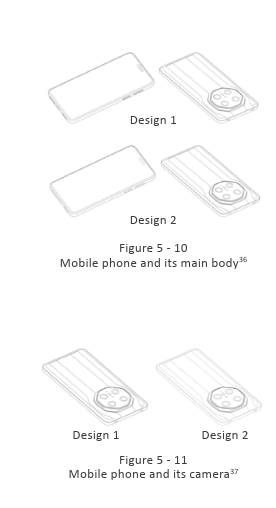
As shown in Figure 5 - 10, for the mobile phone and its main body, Design 1 is the basic design. Design 2 has the same overall shape and structure as Design 1. The difference is that Design 2 does not claim protection for parts such as the front - facing camera, speaker, buttons, and interfaces of the mobile phone. The above differences are minor parital changes, and the two are similar designs.
As shown in Figure 5 - 11, for the mobile phone and its camera, Design 1 is the entire design of the mobile phone and is the basic design, while Design 2 is the partial design of the mobile phone's camera. Compared with the mobile phone in Design 1, the overall visual effect of the camera claimed in Design 2 is quite different, which does not belong to minor partial changes, and the two are not similar designs.
2.2.2 Partial and Partial
To illustrate whether partial designs are similar or not, several common scenarios are introduced below.
2.2.2.1 Differences lie in minor partial changes
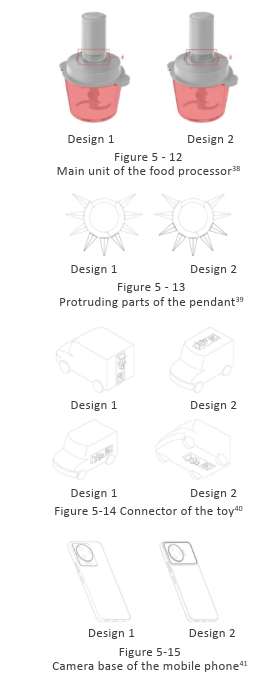
As shown in Figure 5 - 12 for the main unit of the food processor, both Design 1 and Design 2 claim protection for the grey main unit part. Design 1 is the basic design. The main difference between them is that the surface concave - convex textures of Part A and Part B in the middle of the food processor's main unit are different, which belongs to minor partial changes. The two are similar designs.
2.2.2.2 Differences lie in the repeated arrangement of design units
If the parts claimed by other designs have the same design features as those claimed by the basic design, and the differences lie in the repeated arrangement or the increase or decrease in the quantity of design units, they are similar designs.
As shown in Figure 5 - 13 for the protruding parts of the pendant, Design 1 is the basic design. Compared with Design 1, the difference in Design 2 lies in the different quantity of the protruding parts of the pendant to be protected, which belongs to the repeated arrangement or the increase or decrease in the quantity of design units. The two are similar designs.
2.2.2.3 Differences lie in the regular changes of the position and/or proportional relationship of the partial design in the whole
If other designs have the same design features as the partial design protected by the basic design, and the only difference lies in the regular changes of the position and/or proportional relationship of the partial design in the whole, then this design and the basic design belong to similar designs.
As shown in Figure 5 - 14, for the connecting part of the toy, Design 1 is the basic design. Designs 1 to 4 all claim protection for the partial design of the connecting part of the toy. Compared with the basic design, the main difference in the parts claimed by Designs 2 to 4 lies in the regular changes of the position of the connecting part in the whole product. Designs 1 to 4 belong to similar designs.
As shown in Figure 5-15, for the camera base of the mobile phone, both Design 1 and Design 2 claim protection for the partial design of the camera base of the mobile phone. Design 1 is the basic design. Compared with Design 1, the main difference of Design 2 lies in the regular changes in the position and proportional relationship of the camera base in the overall product. The two belong to similar designs.
2.2.2.4 Situations not belonging to similar designs
If different parts of the same product are claimed for protection, the above partial designs usually do not belong to similar designs.
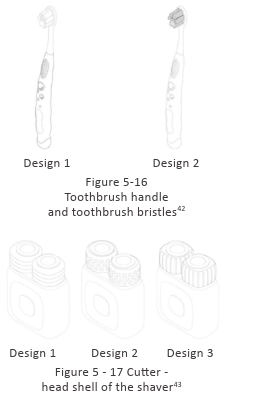
As shown in Figure 5-16, for the toothbrush handle and toothbrush bristles, Design 1 is the basic design. Although Design 1 and Design 2 belong to the same product, compared with the toothbrush handle claimed for protection in Design 1, the toothbrush bristles claimed for protection in Design 2 are significantly different in shape, structure and other aspects of the design, which do not belong to minor partial changes. The two do not belong to similar designs.
If partial designs of the same part of the same product are claimed for protection, but the overall visual effects of the above partial designs are significantly different, they do not belong to similar designs.
As shown in Figure 5 - 17, for the cutter - head shell of the shaver, Design 1 to Design 3 all claim protection for the cutter - head shell of the shaver. Design 1 is the basic design. Compared with the cutter - head shell claimed in Design 1, the cutter - head shells claimed in Design 2 and Design 3 have significantly different shape structures and obvious differences in the overall visual effect, which do not belong to minor partial changes. Design 1 to Design 3 do not belong to similar design of appearance.
Chapter 6 Special Situations of Combined Applications
1. The design application for a set of products shall not include similar designs of appearance.
Section 9.2.4, Chapter III, Part I of the Guidelines for Patent Examination stipulates that the patent application for the design of a set of products shall not include similar designs of one or several products.
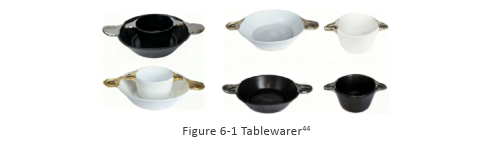
As shown in Figure 6 - 1, the tableware requests protection of colors. Among them, bowls and plates in the same color can be applied for in combination in the form of a design for a set of products. Bowls in different colors belong to similar designs, and plates in different colors also belong to similar designs. However, the design for a set of products shall not include similar designs of appearance. For example, the patent application for the design of a set of products of black bowls and black plates shall not include white bowls, which are similar designs of black bowls, and white plates, which are similar designs of black plates.
In addition, similar designs shall not include the design of a set of products.
2. The design patents for multiple component products with similar designs can be filed together.
Under the condition of being the same product, an application for a design patent is allowed to include similar designs of multiple component products. Each design of the component product as a whole should form a similar design to the basic design. If there is no assembly relationship between the components of the component product, the components of other designs should meet the requirements of similar designs compared with the components of the basic design.
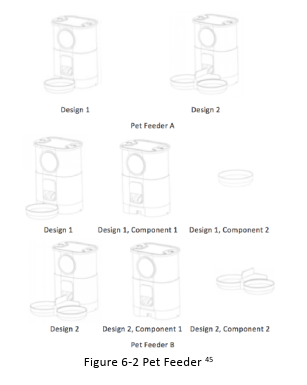
As shown in Figure 6-2, for the pet feeder A, Design 1 is the basic design. Compared with the basic design, the main difference of Design 2 lies in the number of feeding trays. Design 1 and Design 2 belong to similar designs.
If the feeding tray is a detachable independent part, as shown in Figure 6-2 for the pet feeder B, both Design 1 and Design 2 are component products and each consists of two components. The only difference between them is the number of feeding trays. Design 1 and Design 2 also belong to similar designs.
3. It can be applied for as a combined application for the design of a complete set of products or as multiple items of the same product
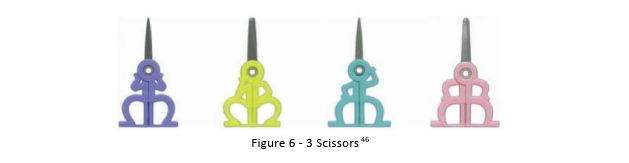
The scissors shown in Figure 6 - 3 are the appearance designs of 4 scissors with the same design concept. To meet the usage needs of different occasions, they are customarily sold or used together. Therefore, they can be applied for as a combined application for the design of a complete set of products. In addition, if the design of the first scissor is taken as the basic design, compared with the basic design, the other three designs only have slight differences in the shape of the top blade and the shape of the middle human - shaped handle, which belong to minor partial changes.
Therefore, they can also be applied for as a combined application for similar designs of appearance.
4. It can be applied for either as the design of a component product or as a combined application for the design of a complete set of products
For the warm wine pot shown in Figure 6 - 4, Component 1 is a wine glass, Component 2 is a water cup, and Component 3 is a wine pot. Component 3 can be placed in Component 2, and by covering it with Component 1, the warm wine pot in the combined state is obtained. Therefore, it can be regarded as a component product and applied for in the form of a single design.

In addition, wine glasses, wine pots, and water kettles each have independent use values and also have combined use values. They are usually sold and used simultaneously, have a unified design style, and can be applied for in a combined case in the form of a design for a set of products.
5. Combined application for multiple designs of a series of products
For a series of products designed with the Chinese zodiac or the twelve constellations as the design concept or theme, different protection methods can be selected according to the attributes and characteristics of the products.
Since the maximum number of similar designs in a combined application cannot exceed 10, for a series of products of the Chinese zodiac or the twelve constellations, all 12 similar designs cannot be included in one application. At this time, it can be determined whether a combined application for the design of a set of products without a limit on the number of items can be filed according to whether the products are customarily sold or used simultaneously.
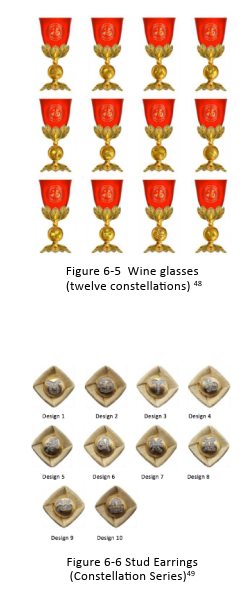
As shown in Figure 6-5, the difference in each design is only the constellation pattern on the hand-held part, which belongs to partial small changes. It can be applied as multiple similar designs for the same product. However, only 10 items can be selected.
In addition, since the wine glasses in this series belong to the same class, are customarily sold or used together, and have the same design concept, they can also be filed as a combined application in the form of a design for a set of products, thus not being restricted by the number of design items.
As shown in Figure 6 - 6 for the constellation - series stud earrings, Design 1 is the basic design. Compared with the basic design, Designs 2 to 10 only differ in the constellation patterns on the central circular protrusion, which belong to minor partial changes in the pattern. Designs 1 to 10 can be filed as a combined application for multiple similar designs of the same product. In addition, this type of product is not customarily sold or used together, so it cannot be filed as a combined application in the form of a design for a set of products.
Chapter 7 Reference Cases
Case 1: Application for the design of a component product
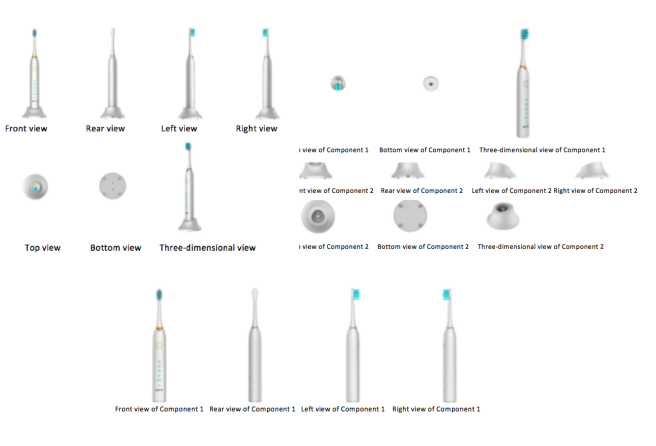
Product name: Electric toothbrush 50 with charging base
[Brief Description]
1. Name of the product of this design: Electric toothbrush with charging base.
2. Use of the product of this design: For cleaning the oral cavity and teeth.
3. Key points of the design of the product of this design: The shape.
4. Picture or photo that best shows the key points of the design: Perspective view.
5. In this design, Component 1 is the toothbrush, and Component 2 is the charging base.
basic design, Designs 2 to 10 only differ in the constellation patterns on the central circular protrusion, which belong to minor partial changes in the pattern. Designs 1 to 10 can be filed as a combined application for multiple similar designs of the same product. In addition, this type of product is not customarily sold or used together, so it cannot be filed as a combined application in the form of a design for a set of products.
Case 2: Combined application for the design of a set of products
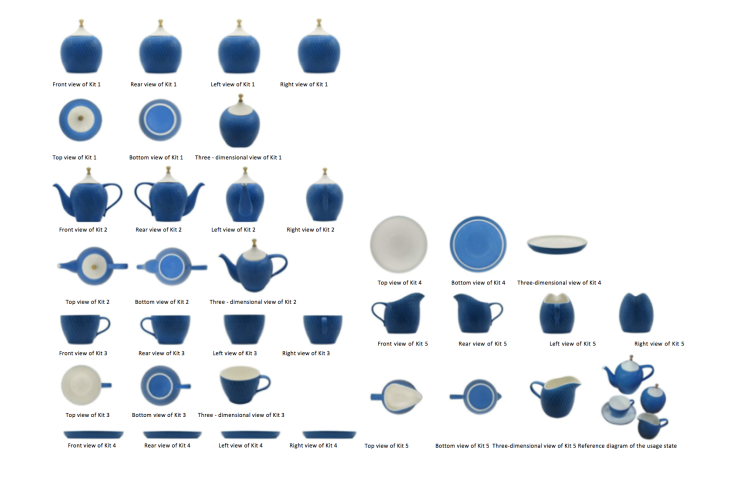
Product name: Set of coffee utensils 51
[Brief Description]
1. Name of the product of this design: A set of coffee utensils.
2. Use of the product of this design: For drinking coffee.
3. Key points of the design of the product of this design: The combination of shape and color.
4. Picture or photo that best shows the key points of the design: Reference drawing of the product in use.
5. In this design, Set 1 is a sugar bowl, Set 2 is a coffee pot, Set 3 is a coffee cup, Set 4 is a coffee saucer, and Set 5 is a creamer.
6. This design requests protection of colors.
Case 3: Combined application for multiple similar designs of the same product
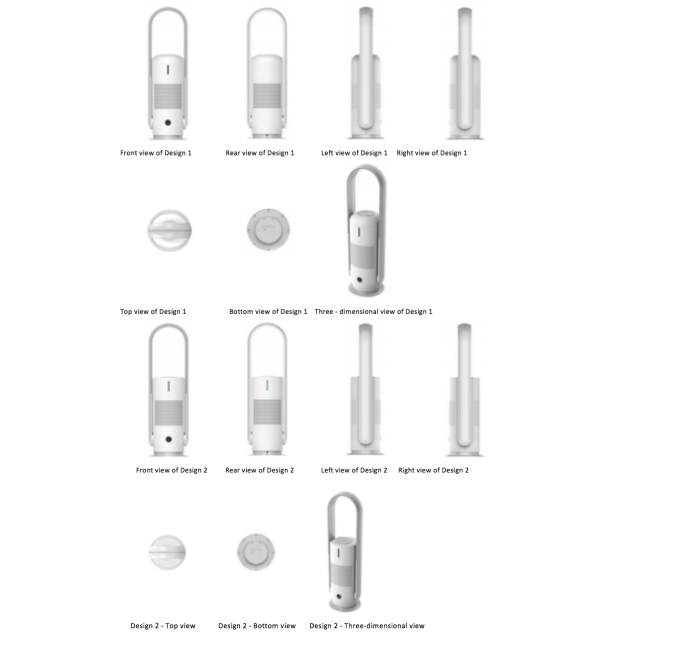
Product name: Bladeless fan 52
[Brief description]
1. Name of the product with this design: Bladeless fan.
2. Use of the product with this design: For blowing air and promoting air circulation.
3. Key points of the design: The shape.
4. Picture or photo that best shows the key points of the design: Design 1 - Three-dimensional view.
5. Design 1 is designated as the basic design.
Case 4: Combined application for partial design
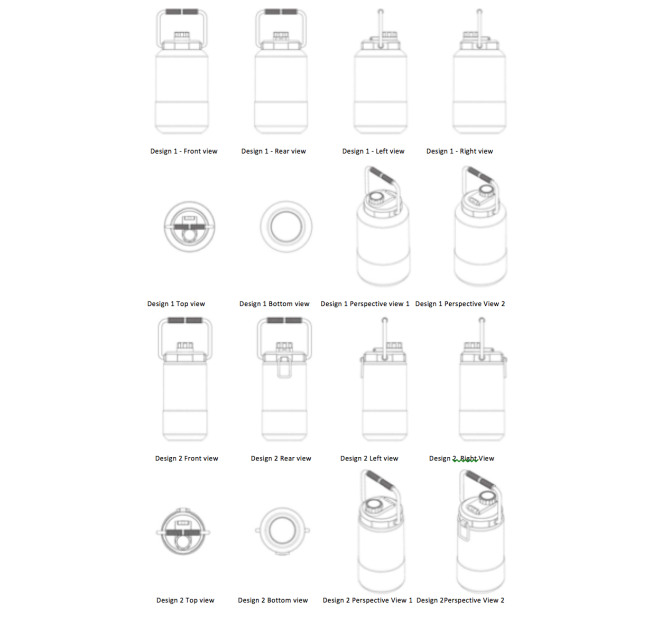
Product name: Kettle lid 53
[Brief Description]
1. Name of the product with this design: Kettle lid.
2. Use of the product with this design: For containing liquids.
3. Use of the part of the product with this design: For closing the kettle.
4. Key points of the design of the product with this design: The shape of the lid.
5. The picture or photo that best shows the key points of the design: Design 1, Perspective View 1.
6. Design 1 is designated as the basic design.
References:
1 Picture source: Patent document CN308840657S.
2 Picture source: Patent document CN309181232S.
3 Picture source: Patent document CN308072265S.
4 Picture source: Patent document CN306462332S.
5 Picture source: Patent document CN307036152S.
6 Picture source: Patent document CN308679525S.
7 Picture source: Patent document CN306827536S.
8 Picture source: Patent document CN307231700S.
9 Picture source: Patent document CN305859735S.
10 Picture source: Patent document CN307199667S.
11 Picture source: Patent document CN305882269S.
12 Picture source: Patent document CN308940276S.
13 Picture source: Patent document CN304829894S, modified accordingly as needed.
14 Picture source: Patent document CN306889736S.
15 Image source: Patent document CN306790302S.
16 Image source: Patent document CN307875437S.
17 Picture source: Patent document CN305046721S.
18 Picture source: Patent document CN307869364S.
19 P i ctu re s o u rces : Patent d o cu m e nt s C N 30 88 63 54 2 S , CN306787236S, CN308075012S.
20 Picture source: Patent document CN307745119S.
2 1 P i c t u re s o u rc e : Pa te n t d o c u m e n t s C N 3 0 4 9 5 4 3 8 5 S , CN307165397S, CN304950030S, with corresponding modifications made as required.
22 Picture source: Patent document CN308594068S.
23 Picture source: Patent document CN308332888S.
24 Image source: Patent document CN305209170S.
25 Image source: Patent document CN308393534S.
26 Picture source: Patent document CN308699548S.
27 Picture source: Patent document CN309092595S.
28 Picture source: Patent document CN308842572S.
29 Picture source: Patent document CN308876822S.
30 Picture source: Patent document CN308482010S.
3 1 P i c t u re s o u rc e : Pa te n t d o c u m e n t s C N 3 0 9 1 7 0 5 9 2 S , CN309153646S.
3 2 P i c t u re s o u rc e : Pa te n t d o c u m e n t s C N 3 0 8 2 7 6 2 8 1 S , CN308869222S.
33 Picture sources: Patent documents CN308869222S and CN308869221S.
34 Picture sources: Patent documents CN308276532S and CN308869222S.
35 Picture source: Patent document CN308735498S.
36 Picture source: Patent document CN309071128S.
37 P i ctu re s o u rces : Patent d o cu m e nt s C N 30 90 71 12 8 S , CN309064303S.
38 Picture source: Patent document CN309007335S.
39 Picture source: Patent document CN308848263S.
40 Picture source: Patent document CN308465607S.
41 Picture source: Patent document CN308419963S.
4 2 P i c t u re s o u rc e : Pa te n t d o c u m e n t s C N 3 0 8 7 0 4 8 5 5 S , CN309025348S.
4 3 P i c t u re s o u rc e : Pa te n t d o c u m e n t s C N 3 0 8 7 4 2 9 5 7 S , CN308779398S, CN308819158S.
44 Picture source: Patent document CN308939776S.
45 Source of the picture: Patent Document CN307654196S.
46 Picture source: Patent document CN301326240S.
47 Picture source: Patent document CN304024933S.
48 Image source: Patent document CN305901291S.
49 Picture source: Patent document CN304985628S.
50 Picture source: Patent document CN305532797S.
51 Picture source: Patent document CN305978401S.
52 Picture source: Patent Document CN306143208S.
53 Picture source: Patent Document CN308867205S.