I. Background & Legal Basis:
Settlement between parties in trademark disputes is grounded in the principle of party autonomy. In recent years, compared to the declining acceptance of consent letters in refusal review cases, settlement practice in opposition and subsequent review proceedings has demonstrated greater flexibility.
Although the current China Trademark Law does not comprehensively address the application of settlement in opposition and subsequent review proceedings, its legal framework is established in instruments, such as:
Trademark Review and Adjudication Rules (2014), Rule 8 During the review and adjudication, an interested party shall have the right of disposal over his trademark right and related rights in accordance with the law.
Without harming public interests or a third party’ s rights, interested parties may reach an amicable settlement agreement in writing by themselves or by mediation.
The Beijing High People's Court Guidelines for Trademark Authorization and Confirmation Administrative Cases (2019), 15.12 Legal effects of coexistence agreements … If after issuing a coexistence agreement, the owner of the prior trademark raises an objection on unapproved registration or request for invalidation on the ground that the trademark in dispute is similar to their prior trademark, then this objection or request shall not be supported, unless such coexistence agreement is invalid or canceled.
However, as the current trademark system maintains a framework of public oversight, settlements reached in opposition and subsequent review proceedings are not automatically effective and must be examined for approval. The following case analysis breaks down the key conditions for a successful settlement and highlights common pitfalls to avoid.
II. Admissible vs. Inadmissible Settlements:
i. Admissible Settlements
Case 1: Withdrawal of Opposition Action Based on Settlement
- Apple Inc. vs. Beijing Yunlian Yiyun Technology Co., Ltd.
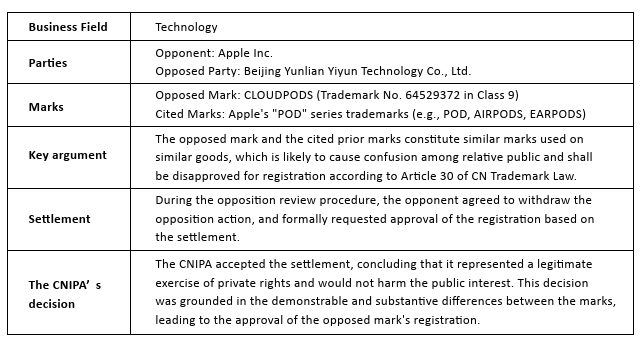
Case 2: Deleting Conflicting Goods Based on Settlement Terms
- Ford Motor Company vs. Zhongshan Yinghe Casters Co., Ltd.
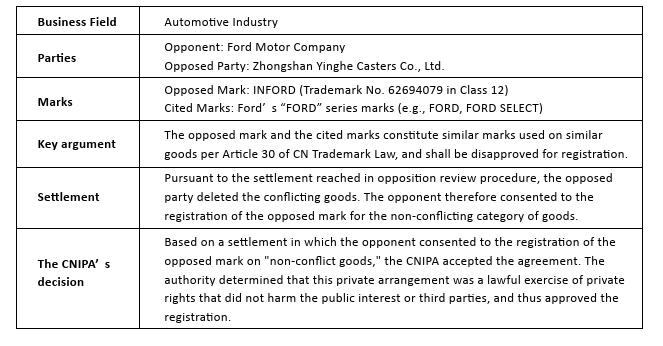
Case 3: The conflict of rights was resolved through trademark assignment
- Foshan Dinghua Zhenzhen Beverage Co., Ltd. vs. Guangdong Zhenzhen Enterprise Management Co., Ltd.
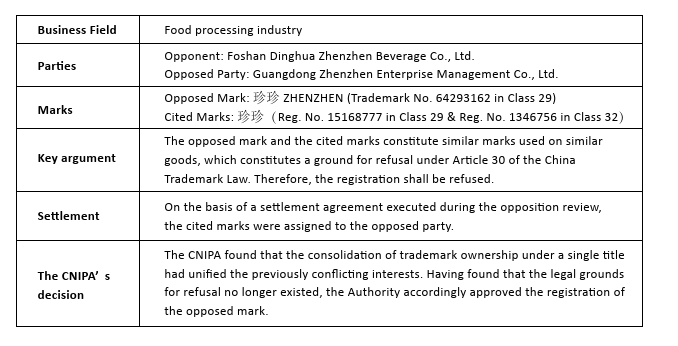
ii. Inadmissible Settlements
Case 1: When marks are confusingly similar, a Letter of Consent is inadequate.
- Monster Energy Company vs. Monster Beverage & Food (Shanghai) Co., Ltd.
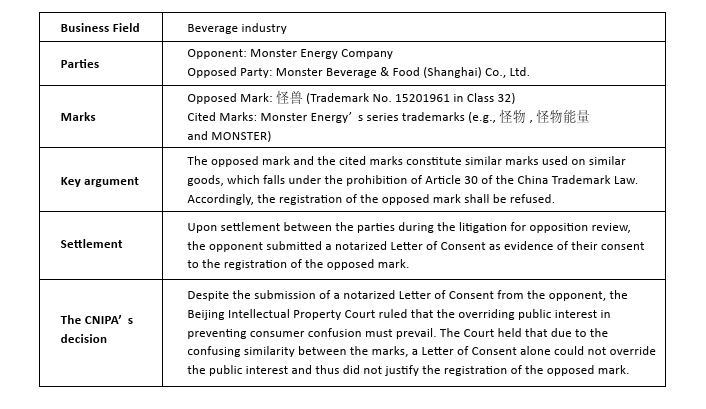
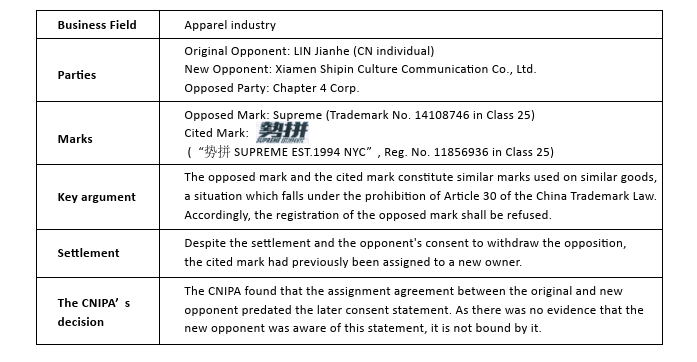
Case 2: Settlement Not Binding on New Right Holder
- Lin Jianhe & Xiamen Shipin Culture Communication Co., Ltd. vs. Chapter 4 Corp
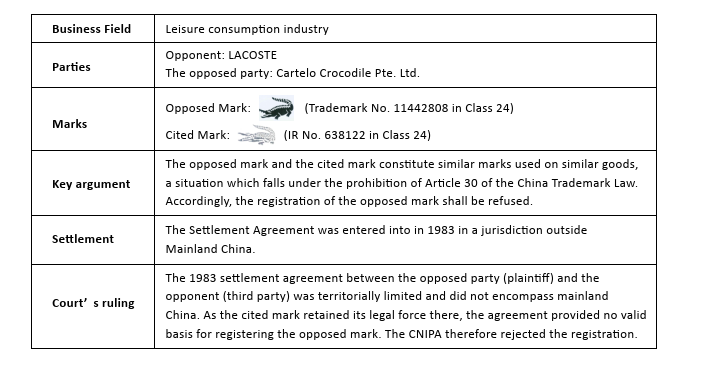
Case 3: Extraterritorial Settlement Agreements Not Recognized
- LACOSTE vs. Cartelo Crocodile Pte. Ltd.
III. Conclusion
Based on the cases reviewed, the following are the key conditions for a successful settlement in opposition or review proceedings:
i. The settlement shall reflect the genuine and mutual intent of both parties.
ii. The settlement shall not adversely affect national or public interests, nor infringe upon the lawful rights of any third-party.
iii. All necessary procedures, such as trademark assignment or recordal of a change in the proprietor’ s name, must be completed before the conclusion of the review proceedings.
iv. In cases where only a letter of consent is submitted, the authority remains obligated to independently assess the similarity of the marks and the associated risk of public confusion.
For the settlement to be effective, the parties should:
i. The settlement cannot validate a trademark filed in bad faith, which remains ineligible for registration.
ii. As the settlement does not automatically bind subsequent owners of the cited mark, the agreement should require the current owner to provide formal notice of this settlement to any potential assignee, making compliance a condition of the assignment.
iii. The settlement agreement, along with proof of its performance, must be promptly submitted to the CNIPA.
iv. The opposed party bears the burden of proving that the marks are distinguishable from each other and thus unlikely to cause public confusion.
To summarize, proactively considering settlement as a strategic option in trademark opposition proceedings represents a sophisticated approach to intellectual property management. This pathway enables parties to efficiently resolve disputes, conserve resources, and convert a potential legal obstacle into a foundation for future collaboration and mutual commercial benefit.