1. Summary
As a key policy tool to incentivize innovation in the Life Sciences Domain, China’ s Patent Term Extension (PTE) system was formally established in the latest Patent Law effective June 1, 2021, aiming to compensate for the patent term consumed by the review and approval process for the launch of new drugs.
Although PTE applications should be submitted immediately after the implementation of the new Patent Law, their examination only commenced after the finalization of PTE rules and the payment of PTE fees. The PTE rules were ultimately established in the Implementing Regulations of the Patent Law and the Guidelines for Patent Examination, which took effect on January 20, 2024. The fee schedule was officially announced in the Notice No. 594 of China National Intellectual Property Administration (CNIPA) on August 6, 2024, which sets a payment deadline of October 26, 2024. As a result, the practical experiences of the PTE system has been in place for only about one year to date.
2. PTE rules
China’ s current PTE rules are stipulated in Article 42(3) of the Patent Law, Rules 80 to 84 of the Implementing Regulations, and Section 3, Chapter 9, Part V of the Guidelines. The key provisions are summarized below, with the“globally new” standard for eligible drugs
and the “one drug, one patent” principle as two critical rules.
1) Eligible drugs
Although both the Patent Law and its Implementing Regulations refer to eligible drugs as “new drugs,” the Guidelines further narrow the scope to “innovative drugs and some modified new drugs that meet specific requirements” , which specifically include:
(1) Chemical drugs of Category 2.1: drugs that form esters or salts from known active ingredients;
(2) Chemical drugs of Category 2.4: drugs containing known active ingredients for their new indications;
(3) Preventive biological products of Category 2.2: vaccines with improved vaccine strains;
(4) Therapeutic biological products of Category 2.2: biological products for their new indications;
(5) Traditional Chinese medicines of Category 2.3: traditional Chinese medicines for their added functions and indications.
The above provisions explicitly exclude those drugs that are already marketed overseas but not yet approved in China, such as chemical drugs of Category 5.1. In other words, in order to be eligible, the drug must not have been approved in any foreign countries at the
time of submitting a New Drug Application (NDA) in China.
This has widespread implications for multinational pharmaceutical companies (MNCs), as their new drugs are typically first launched in markets such as Europe and the United States. As a result, by the time these drugs enter the Chinese market, they often no longer qualify as an eligible “globally new” drug.
2) Eligible patents
Patents eligible for PTE compensation include those for:
(1) Product invention patents covering the active pharmaceutical ingredient (API);
(2) Process invention patents for the preparation of API; and
(3) Medical use invention patents of the API.
It is noteworthy that patents unrelated to the API are excluded, such as those solely covering excipients, adjuvants, or prodrugs/metabolites.
3) Requirements
To be eligible for PTE compensation, the following requirements must also be met:
(1) The grant date of the patent must be earlier than the approval date of the drug;
(2) The patent must be effective at the time of submitting the PTE application;
(3) The patent must not have previously been granted any PTE compensation;
(4) The claims of the patent must cover the technical solutions of the drug;
(5) If multiple patents pertain to the same drug, the patentee should file the PTE application for only one drug;
(6) If a single patent covers multiple drugs, the PTE application based on that patent should cover only one drug.
Among others, the requirement of “patent covers the drug” , and the “one drug, one patent” principle is further explained below.
The requirement that the “patent covers the drug” is a substantive condition, obligating the PTE applicant to provide a feature-by-feature comparison table detailing how the patent claims encompass the technical solution of the drug. While the scope of patent protection is relatively straightforward to determine, identifying the technical solution of the new drug requires consulting the drug registration certificate, package insert, and even regulatory documents such as Section 3.2.S.1.2 of the Common Technical Document(CTD).
In the context of the “one drug, one patent” principle, “one drug” is typically defined by a single marketing authorization approval. This means that if the same drug is approved for a new indication, it will be considered a distinct new drug for PTE purposes. Consequently, to obtain a PTE term for the new indication, a new PTE application must be filed based on a different patent that has not previously been granted PTE compensation, as a single patent protects only one specific drug approval (i.e., one indication) during its PTE term.
4) Timing
The submission of a PTE application must be made within three months from the date of receiving drug marketing approval. If the drug receives conditional marketing approval, it does not trigger the timeline for PTE submission. In such cases, the application must await full marketing approval to file the PTE application; however, the term of the PTE is calculated from the date of receiving the conditional marketing approval.
5) Calculation
Article 42(3) of the Patent Law stipulates that the PTE term shall not exceed five years, and the total effective patent term after the new drug is approved for marketing shall not exceed fourteen years. The PTE term is calculated using the following formula:
PTE term = Approval date of the drug – Filing date of the patent – 5 years
Compared to the PTE calculation in the United States, the PTE calculation in China is relatively straightforward, as it is solely linked to the marketing approval date of the drug (MA date) and the filing date of the patent (Filing date). By correlating these two dates—using the Filing date as the starting point and considering the number of years between the Filing date and the MA date—it is possible to preliminarily determine the availability and duration of the PTE term, as illustrated in the figure below:

In short, no PTE compensation is available if the drug is approved relatively early (from 0 to 6 years after the Filing date); the patent protection will expire in the 14th year following the drug’ s approval if the drug is approved between 6 and 11 years after the Filing date;and the PTE term will be 5 years if the drug is approved relatively later (from 11 to 20 years after the Filing date).
6) Examination and remedy
The examination of PTE application involves both a preliminary examination and a substantive examination. The preliminary examination is conducted by a single examiner, who assesses formalities such as the type of drug, the timing of submission, and the validity of the patent. The substantive examination is carried out by a panel of three examiners, who evaluate substantive issues including the “one drug, one patent” principle and the coverage of the drug by the patent claims.
If the examination confirms that the PTE application meets the requirements for compensation, a PTE decision will be issued, which grants the PTE and includes details such as the claims covering the new drug, the PTE term, the new patent expiration date, the drug approval number, the drug registration certificate number, and the annual fee amount and the payment deadline.
If during the examination it is found that the PTE application does not meet the requirements for compensation, the applicant will be notified by an office action and given at least one opportunity to present arguments and/or amendments. If the application still fails to meet the requirements, a PTE decision will be issued, rejecting the PTE application.
Regarding the PTE decision, the PTE applicant may, within 60 days, file an administrative reconsideration with the CNIPA.
3. Approved PTEs
Approved PTEs can be queried through public channels at: http://epub.cnipa.gov.cn/.
As of September 1, 2025, a total of nine patents granted PTE compensation have been identified. These are summarized in the table below by drug type (chemical drugs, biological drugs, and traditional Chinese medicines (TCM)), each sorted by application date.
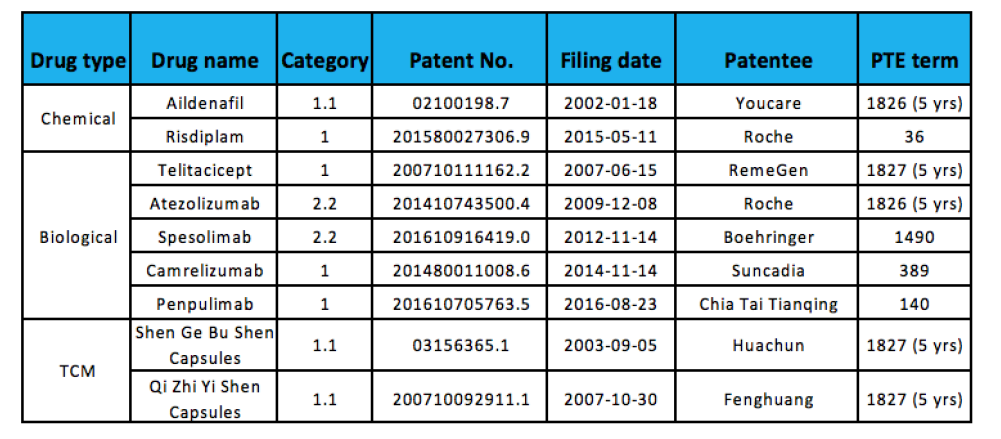
The above table shows that three PTEs have been granted to MNCs. Below provides a brief analysis and calculation of the three PTE applications.
1) Roche: Risdiplam
Roche’ s Risdiplam is a small-molecule drug indicated for patients aged 2 months and above with spinal muscular atrophy (SMA). The drug was approved for marketing in China on 2021-06-16.
The patent application for Risdiplam was filed on 2015-05-11, and granted on 2019-10-15.
Roche submitted the PTE application on 2021-08-12, and received the PTE decision on 2024-11-22. The PTE term is calculated as follows:
PTE term = 2021-06-16 – 2015-05-11 – 5 years = 36 days
The extended patent expiration date is 2035-06-16, and the period from 2021-06-16 to 2035-06-16 lasts exactly 14 years.
The reason Risdiplam received only a 36-day PTE term is primarily due to the relatively rapid approval of the drug. When drug approval occurs within 6 to 11 years from the Filing date, the PTE term decreases as the approval date approaches the 6-year and increases as it approaches the 11-year.
2) Roche: Atezolizumab
Roche’ s anti-PD-L1 monoclonal antibody Atezolizumab is a humanized monoclonal antibody that functions as a programmed cell death ligand (PD-L1) blocker. It was approved in China on 2022-03-18 for a new indication: adjuvant treatment of non-small cell lung cancer (NSCLC) patients.
The patent application for Atezolizumab was filed on 2009-12-08, and granted on 2018-09-21.
Roche submitted the PTE application on 2022-06-16, and received the PTE decision on 2025-04-14. The PTE term is calculated as follows:
PTE term = 2022-03-18 – 2009-12-08 – 5 years = 7 years and 100 days,
which is shortened to 5 years
The extended patent expiration date is 2034-12-8, and the period from 2022-03-18 to 2034-12-08 does not exceed 14 years.
In summary, Atezolizumab received a maximal PTE term of 5 years (1,826 days) because the drug approval occurred relatively late (i.e., the approval date is later than 11 years after the Filing date).
3) Boehringer Ingelheim: Spesolimab
Spesolimab, developed by Boehringer Ingelheim, is a humanized monoclonal antibody targeting the interleukin-36 receptor (IL-36R). It is primarily indicated for the treatment of generalized pustular psoriasis (GPP) flares in adults, and was approved for marketing in China on 2022-12-13.
The patent application for Spesolimab was filed on 2012-11-14, and granted on 2020-12-11.
Boehringer submitted the PTE application on 2023-03-10, received a notice to correct formalities on 2024-09-26, and obtained the PTE decision on 2025-06-20. The PTE term is calculated as follows:
PTE term = 2022-12-13 – 2012-11-14 – 5 years = 5 years and 29 days,
which is shortened to 5 years
The extended patent expiration date is 2037-11-14. However, since the period from 2022-12-13 to 2037-11-14 exceeds 14 years, it has been shortened to 14 years from 2022-12-13, resulting in a new expiration date of 2036-12-13. The PTE term is 1,490 days, calculated from the original patent expiration date of 2032-11-14 to the new expiration date of 2036-12-13.
In conclusion, Spesolimab was originally eligible for a 5-year PTE term, which was reduced due to exceeding the maximum total effective patent term limit of 14 years.
4. Conclusion
Currently, China’ s PTE system has been successfully implemented, but there are still some issues that deserve attention. In particular, the “globally new” standard for new drugs disqualifies many MNCs from PTE compensation. This exclusion has prompted extensive debate and a thorough judicial review. Whether adjustments will be made in the future remains to be monitored.