On May 29, 2025, Chinese artificial intelligence startup DeepSeek released the first update to its large language model, DeepSeek-R1. The model achieves breakthroughs in both algorithmic efficiency and resource utilization, delivering performance comparable to competitors, Open AI’ s o3, while using far less computing cost. Around the same time, another AI enterprise in Hangzhou, Unitree Robotics, also made strides in the field of AI robots. Its humanoid robot G1 is attempting to promote AI humanoid robots to the consumer market at a lower cost to attract more corporate and individual users.
Market trends indicate that China's emerging AI enterprises are evolving into competitive players in the AI market that cannot be ignored. However, it should be noted that despite the impressive achievements made by these AI enterprises, they still face numerous challenges on their rapid growth path, especially in expanding into international markets. Beyond traditional policy regulation risks and technological competition challenges, emerging AI enterprises must also address the crucial question of whether their technological innovations should be safeguarded through the patent system. This article will explore how to protect the rise of Chinese AI enterprises from the perspective of patent layout.
Current State of Patent layout for Chinese AI Enterprises
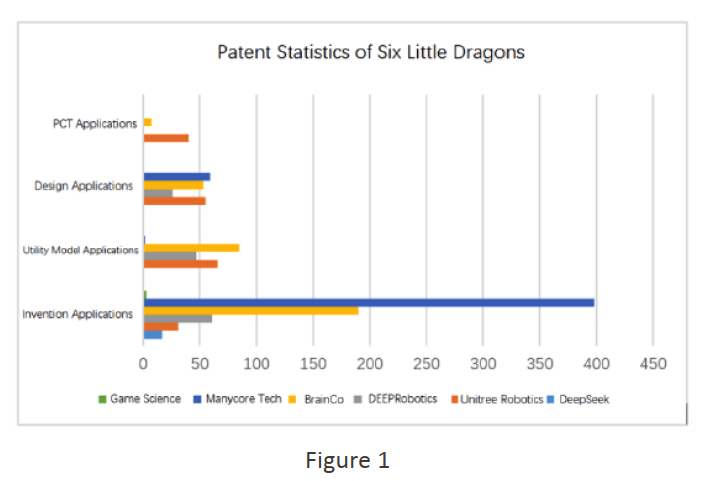
Taking Hangzhou’ s “Six Dragons” : DeepSeek, Unitree Robotics, DEEPRobotics, BrainCo, Manycore Tech , and Game Science , a s examples, these technology innovation companies rooted in Hangzhou have made significant strides in fields such as general artificial intelligence, humanoid robots, brain-inspired intelligence, and large 3A games since 2024, attracting high attention both domestically and internationally. To study the patent layout of these six enterprises, we conducted relevant patent application statistics, as shown in Figure 1.
Upon statistical analysis, among the above six enterprises, Manycore Tech, which was established the earliest in 2011, has also made relatively early efforts in patent applications. After more than ten years of developments, it has accumulatively applied for nearly 400 invention patents. Among those patent applications, the subject matter related to its main business areas (the AI technology and the specialized graphics processing unit (GPU) clusters) account for the largest share of the company's patent layout. BrainCo, which ranks second in patent applications and was established in 2018, is a high-tech enterprise dedicated to the research and application of non-invasive brain-computer interface technology. Patent applications in the category of bioanalytical materials are the company's primary applications. In addition to these two enterprises, through similar analysis, we can see that most of the patent applications of the six enterprises are related to their main businesses. It can be said that the above-mentioned enterprises have completed their initial patent layout.
However, it should be pointed out that, besides Manycore Tech and BrainCo, which have relatively larger patent application pools, the number of invention patent applications for the remaining four enterprises are less than 100, indicating a smaller scale of patent layout. In addition, it seems that the six enterprises have not paid enough attention to the overseas layout of patents. Except for Unitree, which has applied for a number of PCT patents comparable to its domestic patents and actively carried out overseas layout for patents, the other five enterprises do not seem to have actively plans for overseas patent applications for their products.
The reasons for the above phenomena may include the follows: (1) Most of the six enterprises are startups established in recent years, and are in the early stages of the company’ s development. These enterprises need to quickly establish technological advantages,with management focusing on research and development and technological iterations, leading to insufficient investment in patent layout; (2) At present, their products have not yet been launched in overseas markets or relevant product export plans have not been formulated, so the overseas layout of patents has not been carried out in a timely manner; and (3) For AI technologies related to large language models, enterprises may prefer to protect their innovations through means other than patent applications, such as trade secret protection.
To systematically investigate how contemporary AI enterprises protect algorithm-related technological innovations, we conducted a patent analysis of leading domestic startups developing Large Language Models comparable to DeepSeek, with the quantitative results illustrated in Figure 2.
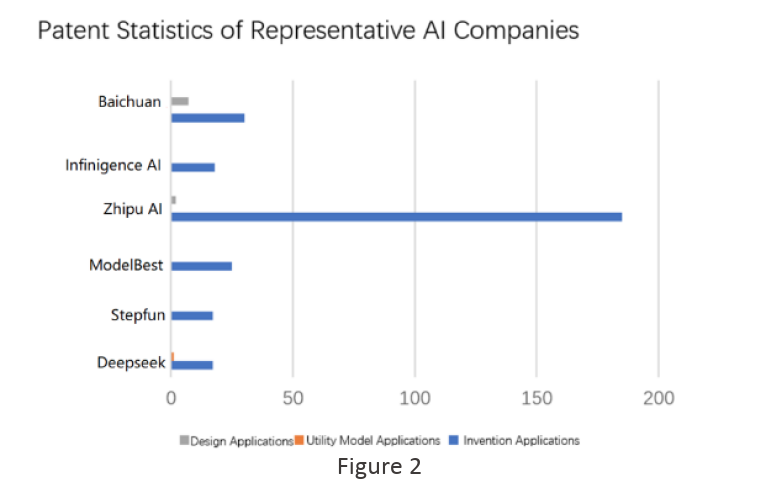
In this statistics, we selected five large language model companies, namely Stepfun, ModelBest, Zhipu AI, Infinigence AI, and Baichuan AI, for analysis. Although these five enterprises differ in their technical routes, for example, Stepfun and Zhipu AI focus on general large models, ModelBest emphasizes open-source tool ecosystems, and Infinigence AI specializes in computing infrastructure, these five enterprises have gained market recognition in technology alongside DeepSeek and can serve as representatives of Chinese large language model AI enterprises.
Referring to Figure 2, although we see that Zhipu AI has been relatively active in domestic invention patent layout among the six enterprises, for most of the other enterprises, patent applications and overseas patent layout have not yet received sufficient attention. This also reflects the current status of patent layout for current domestic AI enterprises related to algorithms: (1) Firstly, the overseas launch of large language model AI products still needs to face numerous local legal compliance issues. Therefore, before deciding to launch their products, AI startups are still unwilling to conduct patent layout for their technologies to save costs and improve efficiency; (2) Secondly, the iteration speed of AI technology is too fast, and patent applications may lose their protective value due to technological obsolescence; and (3) Thirdly, for technological innovations in algorithms, which are more difficult to conduct reverse engineering compared to hardware products, most enterprises still follow traditional thinking and preferentially choose to protect them as trade secrets. However, whether this traditional strategy is still an advantageous choice in the increasingly competitive AI industry today is a question worth discussing.
Patent Layout Strategies that Emerging AI Enterprises Should Adopt
(1) With the enhancement of AI computing power, AI enterprises are prompted to consider patent layout for their core technologies.
With the development of hardware such as GPUs capable of parallel computing units, AI computing power has seen exponential growth. This enhancement in AI computing power has made reverse engineering of software-related AI model products possible. Firstly, since AI computing power is positively correlated with the parametric models used in computations, reverse engineering firms can significantly increase the number of computational parameters to deduce parameter distribution patterns from output results. Secondly, the current mainstream large language models are converging towards similar technical architectures (e.g., tending towards the use of Transformer architectures), and this convergence or standardization of technical routes further reduces the difficulty of reverse engineering. In addition, the current network data security environment is complex, with risks of company databases being leaked due to factors such as hacking attacks. For instance, on January 30, 2025, the US-based cybersecurity company Wiz exposed a data breach involving DeepSeek. These issues further increase the risk of AI products being replicated through reverse engineering.
Due to the possibility of such reverse engineering, in February 2025, Hugging Face announced the launch of its Open-R1 project, aimed at conducting reverse engineering on partially open-source DeepSeek-R1 inference models, to create a fully open-source replica of the R1 model.
The risks and current state of reverse engineering prompt emerging AI enterprises to consider protecting their innovative technologies through patents, in addition to protecting them as trade secrets.
(2) The exploration of overseas markets necessitates active overseas patent layout by enterprises.
In addition to strengthening innovation protection through various channels or methods, AI enterprises also need to consider the geographical coverage of their patent layout. As mentioned above, when AI enterprises seek to expand into overseas markets, legal compliance issues in the target markets may lead to difficulties in obtaining product authorization or promotion. For example, in February 2025, countries such as the United States, South Korea, Italy, and India successively announced bans or restrictions on DeepSeek's products and services based on data security concerns. However, legal risks stemming from local legal compliance do not prevent AI enterprises from profiting from the corresponding countries in overseas markets through patent layout. A recent case illustrating this strategy is Huawei's 5G standard licensing. Since the United States imposed a chip supply ban on Huawei in 2019, Huawei's high-end chip manufacturing and supply chain have suffered severe blows, and the profitability of its terminal businesses such as smartphones has become increasingly challenging. Nevertheless, through its patent layout in 5G standards, Huawei has obtained substantial revenue in overseas markets through patent licensing negotiations and patent infringement lawsuits, serving as a crucial profit supplement for the company. Huawei's successful case serves as a reminder to Chinese AI startups that advance patent layout in potential overseas markets can provide an additional layer of protection against legal risks and that attention should be given to overseas patent layout.
(3) Patent layout is a powerful aid in promoting enterprise development.
Patent protection is a relatively time-taking rights protection system. For startup AI enterprises, they are more inclined to invest resources in model training and computing power upgrades rather than patent layout. However, this does not mean that startup enterprises can skip the critical step of patent layout. On the contrary, startups can screen for core patents by combining product iteration with patent layout. Additionally, enterprises can also adopt advanced patent layout strategies to file patent applications for technologies that are not currently adopted in their product lines but still have prospects to apply, in order to capture potential market share in the future and enhance their future competitiveness.
Furthermore, enterprises at different stages of development have different patent needs. When startups enter a high-speed development phase or become industry leaders, an appropriately sized patent pool can form an effective patent wall to avoid relatedinfringement risks.
Taking Google as an example, in 2012, Google announced the acquisition of 17,000 licensed patents and 7,500 patent applications held by Motorola for $12.5 billion. This acquisition was seen as a move to address patent litigation threats from companies such as Apple and Microsoft against the Android system. Additionally, Google further purchased multiple batches of patents from IBM to compensate for its inadequate patent reserves. Through these series of actions, Google expanded its patent pool to enhance its litigation bargaining power, thereby forcing competitors (such as Apple) to reduce the frequency of patent attacks.
From Google's case, it can be seen that, from the long-term perspective of enterprise development, an appropriately sized patent pool expansion can significantly reduce litigation risks and also contribute to reducing enterprise operating costs. The demand for patent pool expansion also requires AI enterprises to design patent layouts for segmented scenarios, and to employ a hierarchical patent structure to provide comprehensive protection for technological innovation.
Conclusion
Chinese AI enterprises have made remarkable achievements in technological innovation in recent years. However, as of now, there are still deficiencies in the patent layout and patent protection efforts for the Chinese AI enterprises. In the fiercely competitive AI industry,from the perspectives of technological iteration, overseas market expansion, or enterprise development, active and comprehensive patent technology layout is obviously necessary and serves as a powerful booster for promoting enterprise development. While focusing on their own technological reserves and development, Chinese AI enterprises still need to quickly establish corresponding patent layout mechanisms to meet future challenges.